
SEV helps Greek businesses in their path to digital transformation

Interview with Mrs Maggie Athanassiadi, Director, Innovation Division of SEV for the edition “DIGITAL TRANSFORMATION IN GREECE 2022-2023” of Found.ation

How does SEV help Greek businesses in their path to Digital Transformation?

SEV works consistently to support Greek businesses adapt to the realities and needs of our digital economy and society. Its work on digital transformation is organized around three pillars: building business capacities, developing human skills, and advocating for effective policies. The first pillar involves business capacity building and information sharing about new OT/IT trends, opportunities, risks, benefits and best practices. This is done through specialized meetings with experts, workshops, seminars and networking events on topics such as IoT, AI, cloud technologies, connectivity, cybersecurity, digital twins, workflow automations, and so on. Such activities are addressed to all SEV members, regardless of their size, sector or location. The second pillar, digital skills, centers on mobilizing businesses, as well as academic and vocational training institutions, to help the economy and society move faster towards the digital era. SEV collaborates with Universities and research centers to this end, given that some 85% of jobs that humans will perform by 2030 have yet to be developed and will be directly related with the digital transition. As part of the third pillar, SEV advocates for policies and incentives to help Greek enterprises integrate digital tools and new technologies into their operation and management processes, afford costs of the digital transition, and invest in digital training. For example, as a Social Partner, SEV is actively engaged in consultations on new funding schemes for digital transformation under RRF and EU’s structural funds 2021-2027 (aka ESPA). Recently announced tools respond to different business levels of digital maturity, while application and evaluation procedures are simplified and faster. SEV advocacy is also related with digital governance and enhanced digital interactions between public administration and businesses. A lot has already changed on that front, and hopefully more is coming.

What are the biggest challenges of Industry 4.0 for Greek enterprises? Which sectors have fallen behind and which are considered pioneers?

Greek businesses are starting their digital transition from quite a low starting point compared to European economies, or other competitors. According to DESI 2022, and despite progress since 2019, Greek enterprises are still underperforming their EU counterparts in terms of integrating digital technologies, ranking 22/27. The longer it takes to bridge the gap, the bigger the competitiveness loss. Therefore, it is important not only to move forward, but also at a much faster pace. Regardless of the sector – be it industrial manufacturing, food processing, logistics, pharmaceuticals, retail, ICT, services – the businesses that stand out are the ones that are already envisioning a digital future.

Which technologies or tools should Greek businesses focus on in 2023? How can they stay relevant and competitive at a global level?

There is an interesting paradox here. Greek enterprises invest in their digital transformation more than the EU average, ranking 11/27 according to DESI 2022. However, most investment is in I3.0 or I2.0 tools, rather than in cutting-edge technologies like AI and machine learning, IoT, AR, etc. Furthermore, only 39% of Greek SMEs have at least a basic level of digital intensity, compared to the EU average of 55%. Bearing that in mind, SEV works to help businesses develop a digital mindset and adopt advanced technologies as sine qua non factors of value creation and competitiveness.

How much has the digital transformation of the public sector helped Greek enterprises in the last two years?

The change is obvious, as 21% of digital services available on the gov.gr platform involve digital interaction between businesses and public administration. Digitalizing processes, and simplifying them along the way, makes a difference in terms of saving time and resources, as recent SEV research confirms. It should be noted that, during the pandemic, emphasis was given on digital interaction with citizens, and rightly so. Enterprises are now eager to see more digital steps related with doing business and investment, such as interoperability of different public administration platforms and registries, or digitalizing processes related with state aid, taxation, public procurement, commerce, trade, logistics, cargo, invoicing and the supply chain.

What are your predictions or hopes for the year ahead?

Let’s start with the hope that it will be more peaceful! Consecutive crises in the last years have shown us that predictions make little sense. However, change is a constant, and in particular technological change. I hope that Greek enterprises will see the opportunities that technological change offers, and act on it, by not being afraid to explore alternative I4.0 solutions for their production and operation processes. Given that €0,5bn is already available to enterprises under the RRF and ESPA, we can be both pragmatic and optimistic about the future of the economy’s digital transition.
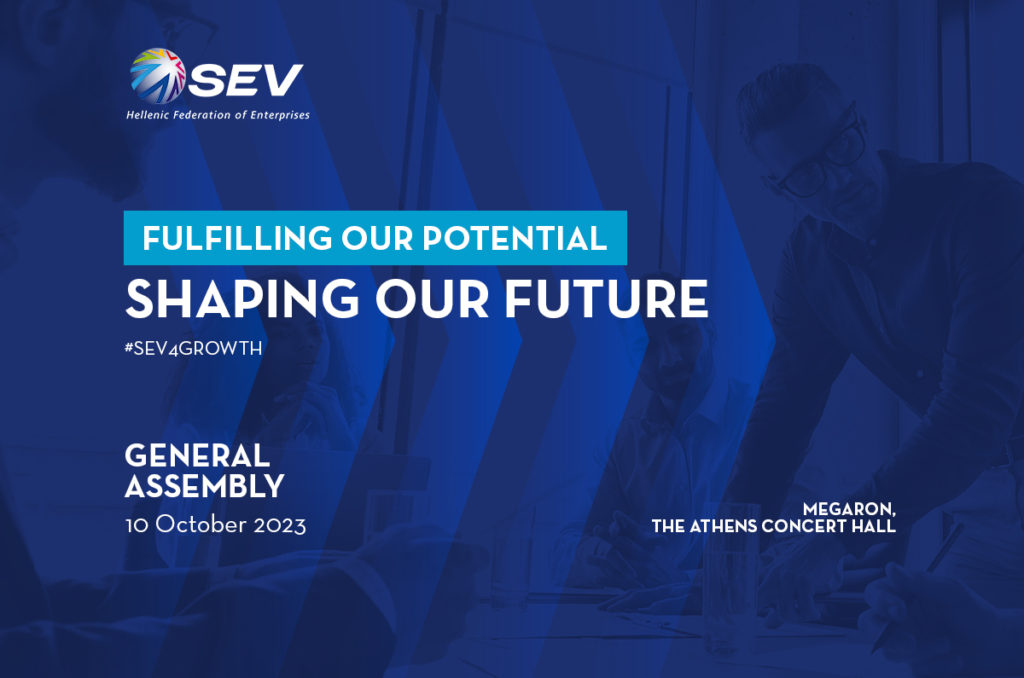
 

Public event of SEV’s General Assembly 2023

“Fulfilling our Potential – Shaping our Future” #SEV4Growth

Public event of SEV’s General Assembly  |  Megaron, the Athens Concert Hall, Alexandra Trianti Hall  |  Tuesday, October 10th, 2023, 19:30 (ΕΕΤ)  

Discussion:

  • Mr. Kyriakos Mitsotakis, Prime Minister of the Hellenic Republic
  • Mr. Dimitri Papalexopoulos, Chairman of SEV

Moderation: Nicky Lyberaki, Journalist

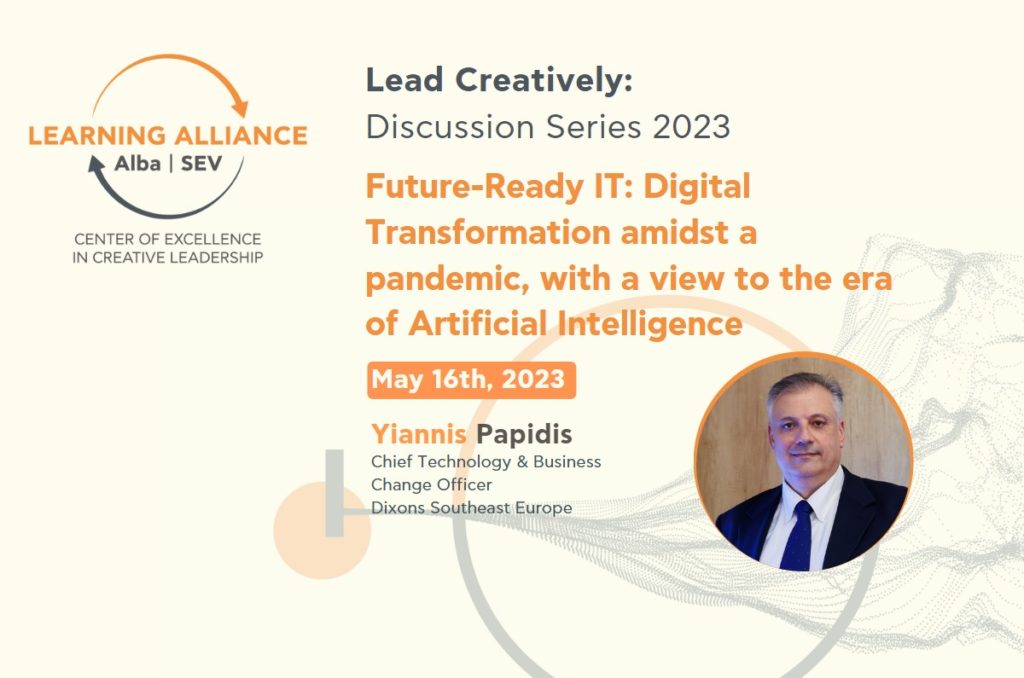
Future-Ready IT: Digital Transformation amidst a pandemic, with a view to the era of Artificial Intelligence

The SEV Center of Excellence in Creative Leadership invites you to its upcoming event entitled “Future-Ready IT: Digital Transformation amidst a pandemic, with a view to the era of Artificial Intelligence”, on Tuesday, May 16, 16:00-17:30,  at Alba Graduate Business School (Xenias 6-8, Athens)

The event will be held in Greek and will be broadcast via livestream.

Register here

Short Description

Given the successive crises, surprising shocks, and disruptive opportunities and threats, every business needs readiness, agility, capabilities, and tools not only to respond, but to stay ahead of the curve.

How do businesses leverage digital technologies to replace their infrastructure, improve customer experience, optimize their operations and empower their employees? What are the best practices, lessons and future trends shaping the digital transformation strategy? How can we prepare our infrastructure and human resources for the era of artificial intelligence that is already transforming every industry and sector?

Yiannis Papidis will present the case study of Kotsovolos who successfully navigated the digital transformation while at the same time having to re-arrange its priorities during the pandemic.

Come to the event venue earlier to interact with the demo of the innovative retail advertising platform that Kotsovolos has developed.

Healthcare and Life Sciences – An industry with significant potential for Greece

Article by Dr. Costas Troulos, Senior Advisor, Innovation Department, SEV Hellenic Federation of Enterprises, at ECONOMIA

As Greece bounces back from a long period of dire financial challenges, healthcare and life sciences emerge as a vibrant sector with strong potential for the country. The remarkable growth of the sector is reinforced by local entrepreneurial activity (startups), Greek pharma investments, and the strategic interest of global giants such as Pfizer. Acknowledging the unique opportunity, SEV (Hellenic Federation of Enterprises) recently launched a working group for the healthcare and life sciences innovation ecosystem. The aim of the group is to share experts’ knowledge and experiences, give critical updates on global developments and trends, and facilitate synergies and collaborations among the stakeholders, including pharma, startups, researchers, funds, and other institutions that support innovation.

Global pharma grows in record rates

The global pharmaceutical industry accounts for nearly EUR1.2 trillion and grows at an annual rate between 3 and 7%. Within the pharma industry, digital health grows by nearly 40% YoY – that is 10 times faster than the entire industry. Moreover, investments in adjacent and relevant sectors account for $70 billion. These money are invested in pharmaceutical and biotech research outside the big pharma, e.g., in startups, SMEs, incubators/accelerators, research centers and universities. Total investments in healthcare start-ups worldwide exceeded $100 billion in 2021 (record year), whereas healthcare investments increase by ~21% YoY, and digital health investments by ~27% YoY. Finally, 65% of drugs and diagnostics licensed in America and 35% in Europe come from industry collaboration with universities and startups.

Strong innovation potential to exploit the global opportunity

The Greek pharmaceutical industry plans to invest more than EUR1.2 billion in production, high-tech equipment, and R&D, over a four-year period. In addition, exports rose to EUR2.9 billion in 2020 up by 48.3% from 2019. With regards to the country’s startup ecosystem, evidence from Elevate Greece suggests that health-tech represents 14.1% of the startup innovation. Finally, top-class medical centers and research infrastructures are available in the country.

Greek startups are active but could use a strong push to scale up fast

Based on a recent study of SEV, more than half of the health-tech startups are in digital health and offer disease management, telemedicine, and wellness platforms. Other solutions in the ecosystem include diagnostic tests (a sector that grew fast during the pandemic), and medical devices. Nearly 70% of the companies in the ecosystem are young (ie. at early funding rounds) and are looking for funding from financial and strategic investors. Finally, 57% of the startups would look forward to meeting with a leading technology and market advisor, from the Greek Diaspora, to help them evaluate and further develop their products.

An imminent call to action

Our research offers critical conclusions and a clear direction for action: a) the industry needs investment to grow quickly and sustainably, b) it is critical to exploit synergies among the big corporations, funds, universities, and startups, and c) the industry needs an innovation ecosystem that supports the growth and success. In this context, SEV identifies three key areas of support and is placing significant effort and resources:

Business development. The companies in the ecosystem are primarily export driven and always look at the global channels for sales and growth. Funding is a critical element for developing the business fast. Mentors from the Greek Diaspora would greatly benefit startups and bigger companies in the industry.

IP management. The management of IP rights is a domain where the startups and SMEs need improvement and support. Also, Greece needs to develop a favorable and easy to navigate IP system, within the entire range from technology development in the university to IP commercialization.

Product development. The collaboration of start-ups, established companies and the public sector can lead to co-development of products that explore breakthrough innovation, market knowledge and distribution. The participation of the public sector is also beneficial for facilitating pilots, reimbursement schemes, etc.

SEV believes that the national innovation ecosystem will become sustainable only when stakeholders acknowledge its contribution to their success, and as a result, profits are reinvested in and capitalized by the ecosystem. To this end, SEV will continue to contribute to the development of an enabling framework that offers collaboration opportunities and makes critical resources for growth available.