
European social partners framework agreement on digitalisation
The digital transformation of the economy is a multifaceted topic with large implications for labour markets, the world of work and society at large. It is dealt with in a variety of ways by EU member states, due to different social and economic situations, labour markets and industrial relations systems and existing initiatives, practices and collective agreements.
The digital transformation brings clear benefits for employers, workers and jobseekers alike, in terms of new job opportunities, increased productivity, improvements in working conditions and new ways of organising work and improved quality of services and products. Overall, with the right strategies, it can lead to employment growth and job retention.
The transition also comes with challenges and risks for workers and enterprises, as some tasks will disappear and many others will change. This requires the anticipation of change, the delivery of skills needed for workers and enterprises to succeed in the digital age. Others include work organisation and working conditions, work life balance and accessibility of technology, including infrastructure, across the economy and regions. Specific approaches are also needed for SMEs to embrace digitalisation in a way that is tailored to their specific circumstances.
Since the gains are not automatic, we need to adapt our labour markets, education and training, and social protection systems to make sure the transition is mutually beneficial for employers and workers. The EU and national governments have an important role to play, by ensuring that the framework conditions allow and support employers and workers to grasp the opportunities and leave them space to find appropriate solutions to deal with the challenges, bearing in mind that they know best the situation on the ground and what measures are needed to benefit enterprises and workers.
It is also important to take into account the climate and environmental impacts.
Furthermore, a shared commitment is needed on the part of employers, workers and their representatives to make the most of the opportunities and deal with the challenges in a partnership approach, whilst respecting the different roles of those involved.
This framework agreement is the shared commitment of the European cross-sectoral social partners – BusinessEurope, SMEunited, CEEP and the ETUC (and the liaison committee EUROCADRES/ CEC) – to optimise the benefits and deal with the challenges of digitalisation in the world of work.
Aims
This framework agreement aims to:
- Raise awareness and improve understanding of employers, workers and their representatives of the opportunities and challenges in the world of work resulting from the digital transformation;
- Provide an action-oriented framework to encourage, guide and assist employers, workers and their representatives in devising measures and actions aimed at reaping these opportunities and dealing with the challenges, whilst taking into account existing initiatives, practices and collective agreements;
- Encourage a partnership approach between employers, workers and their representatives;
- Support development of a human-oriented approach to integration of digital technology in the world of work, to support/assist workers and enhance productivity;
By:
Outlining a joint dynamic circular process, which takes into account the different roles and responsibilities of the different actors and can be tailored to different national, sectoral and/ or enterprise situations, industrial relations systems, jobs and different digital technologies/tools;
Highlighting concrete approaches, actions and measures, which employers, workers and their representatives can use, according to their specific needs and circumstances, to tackle topics such as skills, work organisation and working conditions.
Destination Greece: Attracting Digital & Innovation Investment

Technology & Digital Transformation

Technology & Digital Transformation
Technology is a driving force of the modern economy and a key enabler of productivity, competitiveness, innovation, and business extroversion. Digital transformation is no longer optional but a prerequisite for sustainable growth and resilience for businesses of all sizes.
SEV aims to contribute to the development of a strong and dynamic technology ecosystem in Greece, with more fast-growing technology companies, stronger research and innovation activity, increased international investment, and the development of high value-added products and services.
At the same time, SEV supports businesses in adapting to the digital era by strengthening their ability to adopt and effectively integrate emerging technologies, data, and digital tools into their daily operations and business models.
- Strengthening Greece’s technology ecosystem and digital economy
Support the growth of the technology sector and related investments, with the ambition for the sector to account for 10% of Greece’s GDP, while promoting innovation, productivity, and high value-added economic activity. - Supporting technology entrepreneurship and innovation
Provide meaningful support to Greek technology startups through know-how, networking, and B2B collaboration opportunities, while strengthening private investment in research and development to foster innovation and the creation of high value-added products and services. - Attracting international technology investment and talent
Promote Greece as an attractive destination for technology investment by encouraging foreign high-tech companies to establish research and development centers, competence hubs, and production facilities in the country, while also attracting specialized talent to strengthen the technological base of the economy. - Promoting the international visibility of the Greek technology ecosystem
Highlight the achievements of the Greek technology ecosystem and strengthen the country’s positioning as a destination for technology and innovation investment. - Supporting businesses in digital transformation
Empower member companies with practical knowledge, tools, and guidance for the design and implementation of comprehensive digital transformation strategies and programs. - Accelerating the adoption of AI and emerging technologies
Promote the responsible, secure, and operationally effective adoption of Artificial Intelligence (AI), Generative AI (GenAI), and other emerging technologies across businesses. - Strengthening data capabilities and data-driven decision-making
Enhance businesses’ capabilities in data management and analytics so they can operate based on reliable data and support informed, data-driven decision-making. - Supporting organizational change and digital resilience
Support businesses in managing organizational change across processes, skills, and operating models, ensuring the effective integration of technology into day-to-day operations, while strengthening cybersecurity and overall digital resilience. - Monitoring technological developments and shaping policy proposals
Systematically monitor technological trends and developments and develop evidence-based policy proposals that support innovation, competitiveness, and digital transition.
- Scale Up Community: Through SEV’s Scale Up Community, SEV provides tailored support to technology startups, helping them accelerate growth and strengthen their business development capabilities.
- Business Days: Through the Business Days initiative, SEV supports networking between startups, industry, and businesses, fostering collaborative projects and the integration of innovative technological solutions into business operations.
- Technology sector development and investment attraction: SEV focuses on strategic sectors where Greece has a comparative advantage – such as health tech, defense tech, and physical AI – developing proposals aimed at accelerating the growth of these sectors and attracting technology-intensive investments.
- Innovative Greeks community: The Innovative Greeks community brings together innovative Greeks from around the world, leveraging the international Greek network to support the growth of technology companies and promote the achievements of Greek innovators through the Innovative Greeks Talks initiative.
- IG@Work platform: The IG@Work platform contributes to attracting highly specialized talent and strengthening the connection between skilled professionals and the Greek technology ecosystem.
- AI, data, and digital transformation workshops: SEV provides specialized information and guidance services through thematic workshops, executive briefings, and hands-on sessions covering AI, Generative AI (GenAI), data strategies, and cybersecurity.
- Upskilling programs for business executives and leadership teams: SEV implements upskilling programs focused on AI, GenAI, data management & analytics, and cybersecurity, helping businesses strengthen digital capabilities across their organizations.
- Organizational transformation and productivity enhancement: SEV develops practical guidance and implementation frameworks for managing organizational change, with emphasis on process redesign, skills upgrading, and the adaptation of organizational structures, ensuring that digital transformation translates into measurable productivity gains.
- Support for compliance with the European AI Act: SEV supports businesses in adapting to the new European AI regulatory framework through initiatives focused on data governance, data quality, and the responsible development and use of Artificial Intelligence systems.
- Cybersecurity and digital resilience readiness (NIS2): SEV strengthens business preparedness for the implementation of the NIS2 framework through targeted awareness initiatives, exchange of best practices in cyber resilience, and actions aimed at enhancing cybersecurity readiness.
- Technology Development & Digital Transformation Observatory: Through the Technology Development & Digital Transformation Observatory, SEV maps the country’s level of digital maturity, identifies weaknesses and gaps, and develops evidence-based policy proposals to support technological advancement and digital transition.
Through its Technology & Digital Transformation Committee, SEV implements important initiatives and actively supports the Greek technology ecosystem.
SEV’s Technology & Digital Transformation Committee works to accelerate the digital transformation of the economy, foster digital skills, develop digital infrastructure, and strengthen the technology sector. By participating in the Committee, members contribute to the implementation of initiatives and actions that respond to the real needs of businesses.

Related
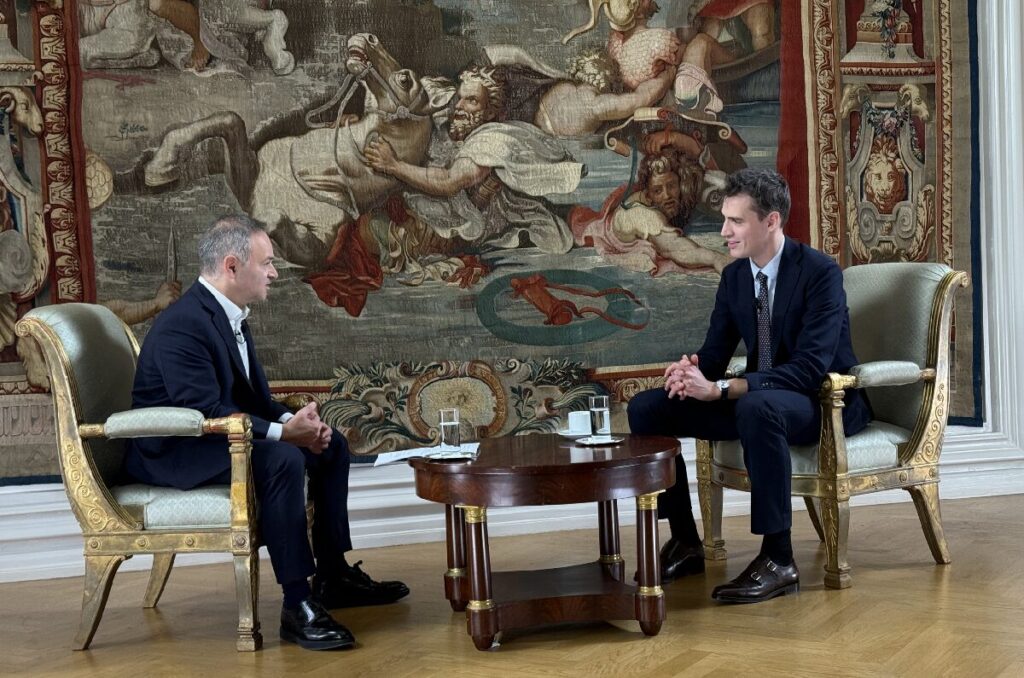
A European AI leader in Athens: Arthur Mensch, CEO of Mistral AI, in a Fireside Chat & Roundtable with top Greek enterprises
The Embassy of France in Greece, in collaboration with SEV – Hellenic Federation of Enterprises and La French Tech Athens, welcomed Arthur Mensch, Co-Founder & Chief Executive Officer of Mistral AI—one of Europe’s fastest-growing and most innovative artificial intelligence companies—to Athens.
As part of his visit, two high-level discussions were held:
- Fireside Chat – Innovative Greeks Talks
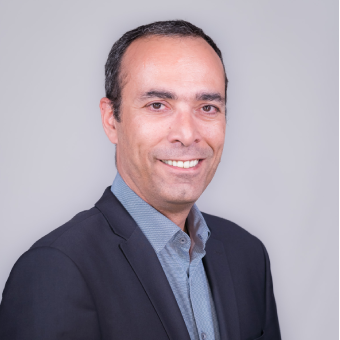
Arthur Mensch participated in an exclusive fireside chat with speaker Markos Veremis, Partner at BigPi and Co-Chair of SEV’s Technology & Digital Transformation Committee.
The conversation focused on:
- Europe’s technological autonomy and competitiveness,
- Mistral AI’s open-source ecosystem and the European origin of its models,
- the conditions required for businesses of all sizes to extract maximum value from practical AI applications, and
- the need for targeted public funding and effective talent-retention policies.
The discussion between Markos Veremis and Arthur Mensch will be posted on the Innovative Greeks Talks channel.
- Roundtable Discussion with leading figures of Greek enterprise
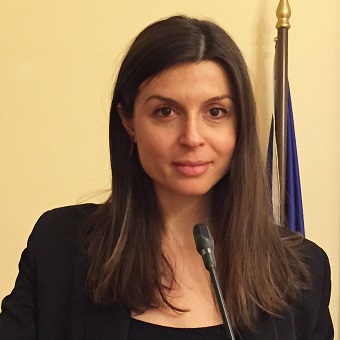
This was followed by a roundtable discussion moderated by Dr. Kyriakos Sabatakakis, Chairman & CEO of Accenture and Co-Chair of SEV’s Technology & Digital Transformation Committee. The discussion featured the President of SEV’s Executive Committee and Vice-President of the Board, alongside entrepreneurs and senior executives from leading Greek companies across industry, energy, banking, services, and retail.
The discussion highlighted the needs and opportunities for Greece’s productive sector in the age of generative artificial intelligence. Participants emphasized the challenges of moving from pilot projects to full-scale deployment, examined the difficulty of prioritizing the multitude of GenAI capabilities, and underscored the role of domain experts in unlocking their value.
Towards a stronger European alliance in artificial intelligence
These activities form part of SEV’s comprehensive set of initiatives aimed at supporting Greek businesses in leveraging AI solutions to strengthen innovation and productivity—while contributing to shaping Europe’s technological leadership. When expertise meets vision, and entrepreneurship meets scientific excellence, collaborations emerge that transcend borders and redefine the challenges of our time.
Markos Veremis, Co-Chair of SEV’s Technology & Digital Transformation Committee, stated: “Europe has the talent, the knowledge, and the vision. My discussion with Arthur Mensch reaffirmed this: the new era of innovation can begin here. An era in which Artificial Intelligence empowers people, businesses, and societies. SEV is committed to ensuring that Greek enterprises are part of this revolution.”
Dr. Kyriakos Sabatakakis, Co-Chair of SEV’s Technology & Digital Transformation Committee, added: “Today’s meeting with Arthur Mensch highlighted that we are at a pivotal moment, where artificial intelligence can become a powerful lever for enhancing the competitiveness and productivity of Greece and Europe. As SEV’s Technology & Digital Transformation Committee, our goal is for the Greek productive base to harness AI’s potential with strategic vision and to play an active role in shaping Europe’s digital leadership.”
According to Mistral AI co-founder and CEO Arthur Mensch: “Greece is a rising force in Europe’s AI landscape, combining bold entrepreneurship, exceptional talent, and a strategic vision for the future. I was honored to discuss the future of AI with some of Greece’s most innovative companies and to announce our new strategic partnership with the Government of Greece. This marks an important milestone in our development in Greece and in Europe, and in our contribution to a more autonomous Europe in AI.”
The presence of Arthur Mensch in Athens contributed to expanding the European dialogue on artificial intelligence and strengthening alliances that can accelerate technological progress at the European level. At the same time, it reaffirmed Greece’s role as an emerging hub for collaboration and knowledge exchange in Southeastern Europe.
SEV, the Embassy of France, and La French Tech Athens reaffirm their commitment to initiatives that enhance collaboration, technological advancement, and the competitiveness of the European and Greek economy.
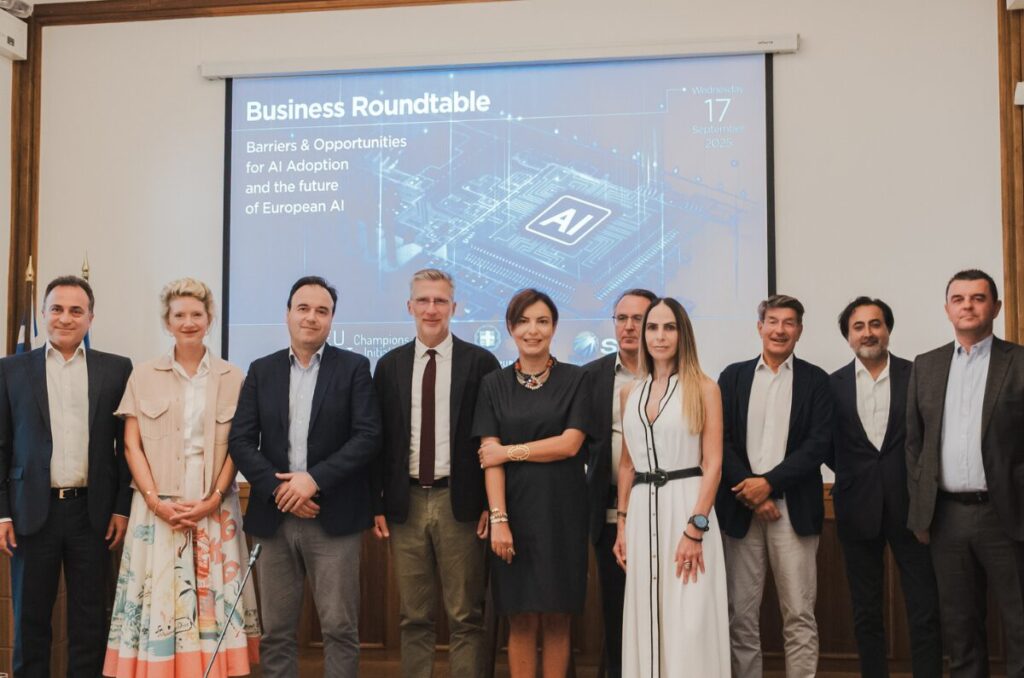
AI Roundtable”: Greece at the heart of Europe’s Dialogue on Artificial Intelligence
“AI Roundtable”: Greece at the heart of Europe’s Dialogue on Artificial Intelligence – An Initiative of the European Commission and General Catalyst, with the Support of the Greek Government and SEV Hellenic Federation of Enterprises
SEV, together with the Greek Government and global investment and transformation company, General Catalyst, co-hosted the Business Roundtable on Artificial Intelligence in Athens, under the EU AI Champions Initiative. This EU initiative is a public-private collaboration that seeks to shape a coherent vision for the future of AI in Europe and beyond – anchored in European values such as human-centric innovation, trust, and transparency. Its aim is to identify, empower, and connect Europe’s most promising AI companies with policymakers, investors, and industrial partners, enabling the EU to compete with global leaders such as the United States and China.
The Greek Government places strong emphasis on the national digital transformation strategy, while stressing that Europe must move from “regulation only” to “regulation plus innovation”, as Prime Minister Kyriakos Mitsotakis recently noted in a discussion with Google DeepMind co-founder and CEO Sir Demis Hassabis. At the same time, SEV actively supports businesses in adopting new technologies and contributes to both national and European consultations on regulatory frameworks. Hosting this Roundtable in Athens is therefore a key step in ensuring Greece has a voice in the European debate shaping the future of AI.
Participants included Minister of State Akis Skertsos, Minister of Digital Governance Dimitris Papastergiou, Jeannette zu Fürstenberg, Managing Director Europe at General Catalyst, Rania Ekaterinari, President of SEV’s Executive Committee, as well as senior representatives from leading industrial and technology companies.
The discussion was held under the Chatham House Rule, allowing participants to exchange views candidly. It focused on agreeing concrete, actionable ways to overcome challenges that hinder the development of a strong Greek and European AI ecosystem and hold Europe back in the global competitiveness race. The discussion aimed to generate concrete use cases of pragmatic digital adoption and recommendations to boost Europe’s innovation capacity, productivity, and technological leadership.
Minister of State, Akis Skertsos stated: “Over the past six years, Greece has gone from being the EU’s ‘black sheep’ to one of Europe’s fastest-growing economies. We have proven that fiscal discipline, pro-investment reforms that cut taxes and red tape, and the digitalization of the state and the economy can transform a country’s trajectory. Today, as we implement our national AI strategy and establish one of the EU’s first AI Factories, we are determined to co-shape the future of our Union by addressing head-on the key dilemmas of our time: Europe must once again become a producer, not just a consumer, of technology—and it must prioritize enabling and encouraging innovation over over-regulation. This is precisely the message of the Draghi Report, which we fully endorse for a strong Greece in a strong Europe, in a rapidly changing world.”
Minister of Digital Governance, Dimitris Papastergiou noted: “Greece has a coherent strategy to harness the opportunities brought by Artificial Intelligence. With data, infrastructure, and talent as our foundations, we are building the basis for a sustainable future of innovation. Our country can emerge as a regional AI hub, playing an active role in Europe and beyond. Our clear objective is a technology that serves people, development, and democracy. We move forward with planning, vision, and confidence into the new digital era.”
Jeannette zu Fürstenberg, Managing Director and Head of Europe at General Catalyst, commented: “Greece exemplifies the kind of public-private collaboration that Europe needs to compete globally in AI. When governments act as true partners, moving at startup speed and serving as anchor customers, we create the flywheel effect that connects startups, industrial champions, policy, capital and talent. The European AI Champions Initiative was born from the urgency to strengthen Europe’s innovation capacity, and Greece demonstrates how ambitious nations can turn strategy into execution. This is the model for keeping AI value creation onshore in Europe while building the resilience our continent needs for long-term competitiveness.”
Rania Ekaterinari, President of SEV’s Executive Committee, stressed in her opening remarks:
“Artificial Intelligence is transforming our world, and Europe must find ways to cooperate more effectively, through deeper public-private partnerships at all levels. Urgent and decisive action is needed, because AI is evolving faster than we are. If we delay, Europe risks remaining a consumer rather than a creator of technology—with consequences not only for competitiveness, but also for its strategic autonomy and security, given its dependence on third countries for critical infrastructure such as powerful cloud systems and advanced semiconductors.”
Finally, Marco Veremis, Chair of SEV’s Technology & Digital Transformation Committee, concluded: “Europe can shape its future in AI by turning its diversity and industrial depth into strengths. To build real momentum, we must invest boldly in research and talent, foster ecosystems where startups and industry collaborate, and adopt smart, enabling regulation that accelerates, not slows, innovation. Manufacturing paired with ΑΙ can become a uniquely European advantage, if supported by flexible frameworks and cross-border cooperation. Each country should focus on areas of true capability, while collectively we set ambitious, realistic goals. With resilience, creativity, and unity, Europe can lead in AI on its own terms, defining progress through its values.”
The Roundtable is part of SEV’s broader strategy to accelerate AI adoption across business and society. Recent initiatives include the “AI in Practice” conference, showcasing concrete applications of AI in the Greek economy; the GenAI Bootcamp in collaboration with Alba Graduate Business School, which has already trained hundreds of executives free of charge; and the forthcoming Practical Compliance Guide for the NIS2 Directive, designed to help companies adapt to the EU’s new cybersecurity framework amid rapid technological change and escalating cyber threats.
BusinessEurope Reform Barometer 2019 – Building an EU for European businesses to succeed globally
BusinessEurope’s EU Reform Barometer 2019 “Building an EU for European Businesses to succeed globally”, published on 20 March 2019, shows that the EU needs to do more to improve its competitiveness as EU growth has now been lower than US growth for 7 of the last 10 years. In addition, the Reform Barometer contains our annual survey of our member federations regarding progress on structural reform.
This year’s Reform Barometer looks in particular at how Europe is falling behind in its ability to develop world-leading firms.
We arrive at this conclusion for 3 reasons:
- None of the top 10 global companies by market capitalisation are European.
- Western Europe’s share of the top 10% of global firms in terms of profitability has dropped from 36% in the late 1990s to 24% now.
- Finally, when considering large high-growth firms/’unicorns’ (start-ups that have reached 1 billion dollar market value within a short timeframe), the EU has not matched other regions when it comes to developing such firms, with the number and average value of unicorns in the EU significantly smaller than those in the USA and China.
Against this background it is concerning that, according to our survey of member federations, governments have failed to step up their reform efforts. Our member federations consider that member states have satisfactorily implemented only 20% of the essential reforms agreed with the EU.
Detailed assessments by national member federations of progress on the country-specific recommendations (CSRs) issued by the European Commission for Greece can be downloaded below.
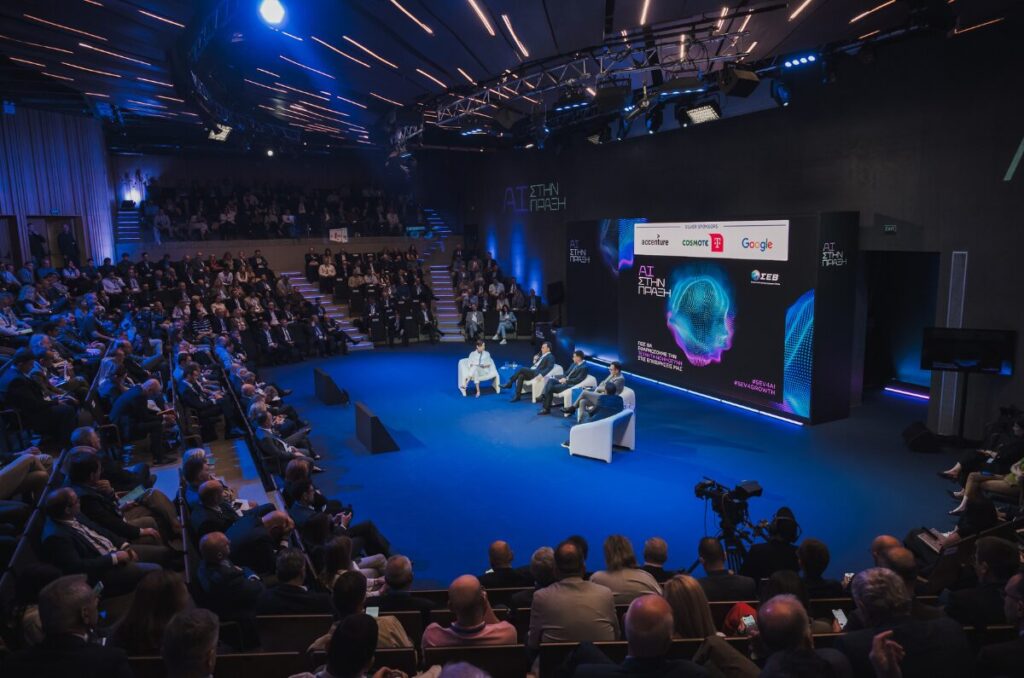
“AI in Action”: SEV’s first conference on Artificial Intelligence showcased real world AI applications by – and for – Greek businesses
- SEV members shared practical examples of AI applications in their companies.
- Only 1 in 4 businesses in Greece currently uses AI, according to SEV’s 2025 “Business Pulse” survey.
- SEV AI Bootcamp in collaboration with Alba: 20 hours of Generative AI training for non-technical executives of member companies.
On Monday, May 12, 2025, SEV held the conference “AI in Action: How to Implement Artificial Intelligence in Our Businesses”. The conference, one of the most targeted initiatives to date, highlighted practical AI applications for Greek businesses to the more than 1,000 business executives from SEV members who attended. Member companies of SEV presented real AI implementation examples in their business operations, showcasing the opportunities, challenges, and prerequisites for AI’s successful integration.
Opening the conference, SEV’s Chairman of the Board, Mr. Spyros Theodoropoulos, noted that “regardless of a company’s level of awareness about Artificial Intelligence, it is now a shared belief that it will decisively impact all our lives in the future and become a critical factor in boosting competitiveness. Greek businesses are starting to cautiously adopt AI, but they must accelerate and invest in the necessary resources and skills.”
The conference featured speakers from 35 companies, organizations, and startups – all early adopters – who highlighted not only the significant benefits of AI utilization but also the importance of dialogue and knowledge exchange to enhance understanding and build trust around AI among Greek businesses.
Specifically, practical applications of AI were presented across many critical aspects of business operations, including productivity, work efficiency, supply chain, marketing and sales, customer service, talent management, predictive maintenance, product research and development, energy management, financial management, and legal support. Dedicated panels and case studies showcased how AI is redefining workplaces, accelerating decision-making, optimizing internal processes, enhancing competitiveness, and supporting sustainable business growth. At the same time, the conditions for the broad adoption of AI, the skills required in the near future, and the strategic importance of technological readiness for Greek businesses were thoroughly analyzed.
This year’s “Business Pulse” survey by SEV included a special section on AI, confirming the need to accelerate its utilization as a factor of enhanced business competitiveness. In detail:
- Only 25.4% of businesses report having even some experience or exposure to Artificial Intelligence (AI). The remaining companies either haven’t started (18.5%) or have no plans to take action in the coming year (55.1%).
- The main areas where AI is already being used or is planned to be used include:
- Marketing & Sales: 56.3%
- Internal Operations: 50.4%
- IT: 35.5%
- The expected benefits from AI utilization, according to companies that already use or plan to adopt it:
- Better use of data: 68.4%
- Reduction of human error: 65.1%
- Process optimization: 63.8%
- Faster and higher-quality decision-making: 59.5%
- Increased productivity: 57.2%
- Improved customer satisfaction: 54.5%
- The greatest challenges in adopting AI:
- Lack of qualified human resources: 39.8%
- Compatibility of AI with existing IT infrastructure: 30.5%
- Limited relevance to the company’s business focus: 29.9%
- Data availability and quality: 29.2%
- Cybersecurity: 29.0%
- The most significant concerns expressed by businesses:
- Loss of sensitive information/data: 36.6%
- Wrong decisions based on AI recommendations: 26.9%
- Regarding the readiness of human resources to meet AI-related business needs over the next 3 years:
- Only 34.5% rate it as “strong or adequate”
- 58.9% consider it “limited or inadequate”
SEV also announced the launch of its new AI Bootcamp, an initiative aimed at developing AI skills within Greek businesses. The program, in collaboration with Alba Graduate Business School, consists of a 20-hour course aimed at non-technical executives of SEV member companies who will lead transformation initiatives using GenAI. The program is designed to:
- Develop understanding of key Generative AI concepts,
- Build and assess use cases with business value, and
- Disseminate knowledge within their organizations.
SEV’s “R U AI?” initiative to promote Artificial Intelligence in Greek businesses also includes other actions. SEV has published a “Practical Guide to AI” and is also running the in-company training program “AI for all”, in collaboration with Google, which has so far trained 1,750 employees from 12 member companies.
Mr. Markos Veremis, SEV Board Member, Head of SEV’s Committee on Technology & Digital Transformation, and Partner at BigPi Ventures, highlighted Larry Summers’ well-known quote: “Artificial Intelligence won’t replace people. But people who use it will replace those who don’t.”
Dr. Kyriakos Sabatakakis, SEV Board Member, Head of SEV’s Committee on Technology & Digital Transformation, and Chairman & CEO of Accenture, stressed: “Businesses integrating Artificial Intelligence into their operations must focus on their human capital to achieve a triple outcome: accelerate the creation of economic value, boost productivity, and offer more meaningful work to those who embrace AI. These employees will multiply their impact, increasing the output of innovative ideas and exploring new fields of activity with much greater ease and speed than in the past – thanks to AI’s capabilities.”
As SEV’s Executive Committee Chairwoman, Ms. Rania Aikaterinari, noted: “Successful adoption of AI doesn’t depend only on technology, but also on people, their training, and the experiences they gain throughout this technological journey. A prerequisite for successful integration is the familiarity and active participation of all employees, because the added value of the human element remains irreplaceable in the benefits that AI can offer.”
“The difficulty lies not so much in developing new ideas as in escaping from the old ones.” With this quote by John Maynard Keynes, SEV’s Chairman Mr. Spyros Theodoropoulos concluded the conference, urging businesses not to fall behind.
Watch the conference here (in Greek)
SEV would like to thank the following sponsors for supporting the event:
- Gold Sponsor: D.I.S. – Dynamic Integrated Solutions
- Silver Sponsors: Accenture, COSMOTE TELEKOM, Google
- Bronze Sponsor: TITAN Group
- Sponsors: Coca-Cola 3E, Grant Thornton, Siemens, UTECO SA, Vodafone, MOTODYNAMIKI
- Reception Sponsor: Coca-Cola 3E
Production and Manufacturing in Greece – ENTERSOFT
IG@work: the new platform connecting highly skilled specialists with industry and technology companies
IG@work, the new digital platform connecting highly skilled specialists with industry and technology companies is now open!
The aim is to attract talent, from Greece and abroad and to support Greek enterprises and startups in finding specialized cadres.
88 companies have already posted more than 400 job postings (here).
Attracting talent, finding highly specialized and experienced people, and connecting them with technology intensive, high-responsibility jobs is a key requirement for business growth.
IG@work is a user-friendly platform which collects quality jobs’ openings that are available in industry and tech startups, and connects them with people searching for repatriation opportunities, or simply for their next professional steps in Greece. Interested parties can search professional opportunities among the hundreds of postings on the platform which already counts more than 400 job postings from 88 companies.
The initiative aims to strengthen companies’ ability to access the people they need, while at the same time, it widens the employment opportunities for the high-level human capital, in Greece and abroad, to work for some of Greece’s largest industries and most dynamic startups.
IG@work is designed and run by SEV’s Innovation Committee in cooperation with Workable and is part of the Innovative Greeks initiative. Access to the service is exclusively for SEV members and the Elevate Greece startups.
Marco Veremis, Chair of SEV’s Innovation Committee notes that: In 2020, SEV’s Innovation Committee launched the Innovative Greeks in order to mobilise the network of Greeks abroad and bring together inventive and innovative Greeks from all over the world. Today, we further strengthen the endeavour with IG@WORK in an effort to contribute to bringing back those young, capable Greeks who left the country during the economic crisis in search of better employment prospects. These young people stemmed from Greek society’s most productive segment, and the vast majority hold university degrees. Greece’s business community fully supports the initiative, and we firmly believe that it will create much value for all, and especially for innovating Greeks.
You can visit the IG@work platform here.
We would also like to thank all those who support the initiative and especially our Mega Sponsors Coca-Cola HBC and Coca-Cola Hellas, our Sponsors Pharmathen and Athenian Brewery and our Supporters ABB S.A., ELVIAL S.A. Sunlight Group – Energy Storage Systems, Hellas Gold, TITAN Group and RAYCAP S.A.