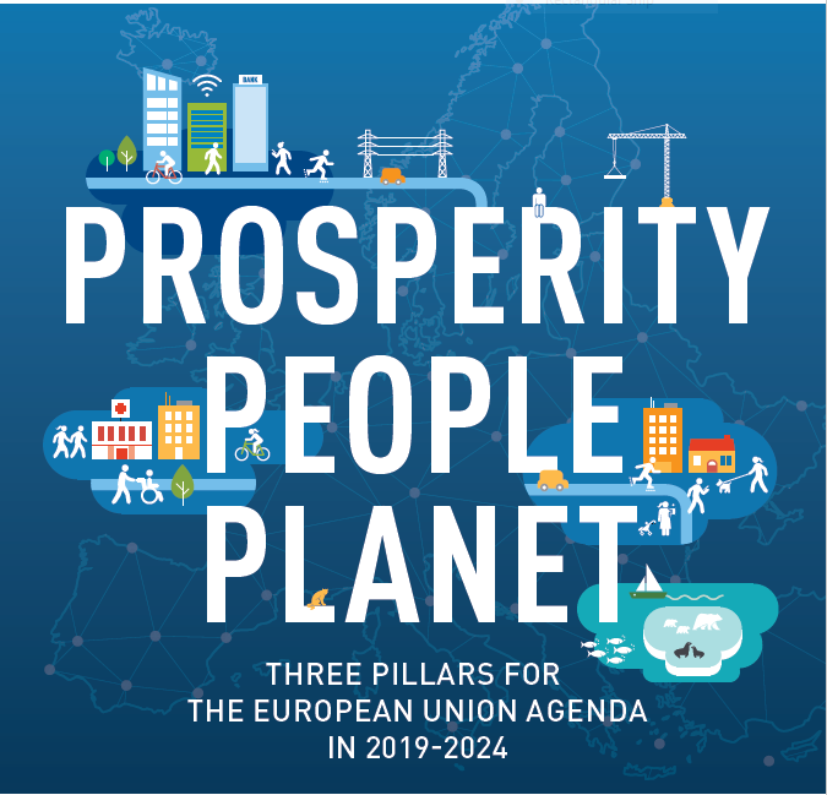
Prosperity, People, Planet: European business priorities for the new EU cycle
BusinessEurope and all its members propose their priorities for the European Union in a new political cycle in 2019-2024. Prosperity, people and the planet – these are the three pillars for a successful Union that should be a source of inspiration for future political decisions.
BusinessEurope President Pierre Gattaz said: “European entrepreneurship has a unique feature. It feels responsible for and cares about prosperity, people and the planet. Companies have a central role to play. Achieving environmental and social goals largely depends on their success: without profitable companies, no inclusive growth, no jobs, no technological solutions to protect the environment.”
European businesses identified 30 priority areas for action by the EU in the coming five years.
“The agenda for the EU for the next 5 years must bring about modern, forward-looking EU policies adapted to the global shifts of the 21st century. The world is on its way to a new geo-economic order. To strengthen European sovereignty, the EU must speak with one voice and row in the same direction. If we want to maintain our standard of living and be a credible example to the rest of the world, we must ensure the economic success of our continent,” Gattaz added.
Read our priorities here: www.euyourbusiness.eua
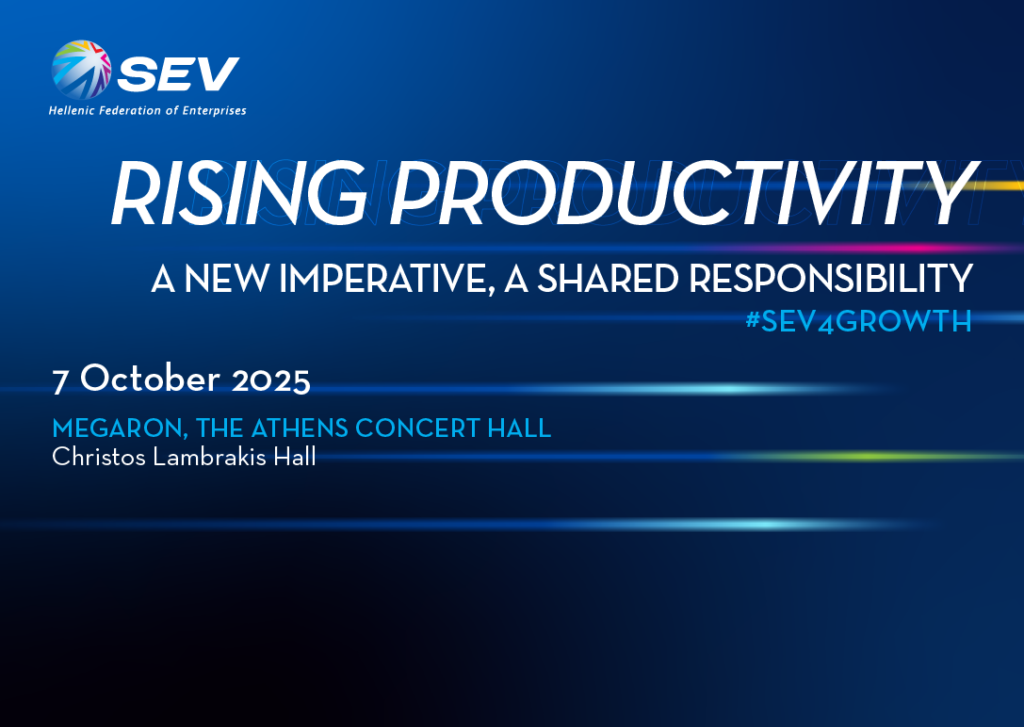
Public Event of SEV’s Annual General Assembly
🚨#WATCHlive here: https://ow.ly/q70p50X7KNL
With the central theme “Rising Productivity: A National Imperative, A shared Responsibility” #SEV4Growth, the Public Event of SEV’s Annual General Assembly took place on Tuesday, October 7, 2025, at the Athens Concert Hall, “Christos Lambrakis” Hall.
A discussion was held between Dr. Joachim Nagel, President of the Deutsche Bundesbank and Member of the Governing Council of the European Central Bank, and journalist Pavlos Tsimas.
Speakers included:
-
Kyriakos Mitsotakis, Prime Minister
-
Spyros Theodoropoulos, Chairman of the Board of SEV
GOLD SPONSORS: ALPHA BANK, JTI Hellas, ION S.A. Cocoa & Chocolate Manufacturers
SILVER SPONSORS: ACCENTURE, AEGEAN, ELVALHALCOR S.A. (ElvalHalcor), HELLENiQ ENERGY Holdings SA, METRO S.A., MOTOR OIL (HELLAS) CORINTH REFINERIES S.A., Olympia Group, Quest Holdings, TITAN Group, UNI-PHARMA S.A.
BRONZE SPONSORS: ELVIAL S.A., People for Business, PUBLIC POWER CORPORATION S.A.
SPONSORS: ABB SA, ATHENS INTERNATIONAL AIRPORT S.A., BAT Hellas, Big Pi Ventures, Coca-Cola Hellas, DEMO SA, DIADIKASIA BUSINESS CONSULTING S.A., DIS – Dynamic Integrated Solutions, ELPEN S.A., Goldair Cargo, HEDNO S.A. Hellenic Electricity Distribution Network Operator S.A., Hellas Gold, HELLENIC DUTY FREE SHOPS, HELLENIC HYPERMARKETS SKLAVENITIS S.A., IMERYS Greece S.A., METLEN – Energy & Metals, NN Hellas, PAPASTRATOS, PIRAEUS, SAP Hellas Single-Member S.A., TEMES, V. KAFKAS SA ELECTRICAL & LIGHTING EQUIPMENT WHOLESALER, YIOTIS S.A.
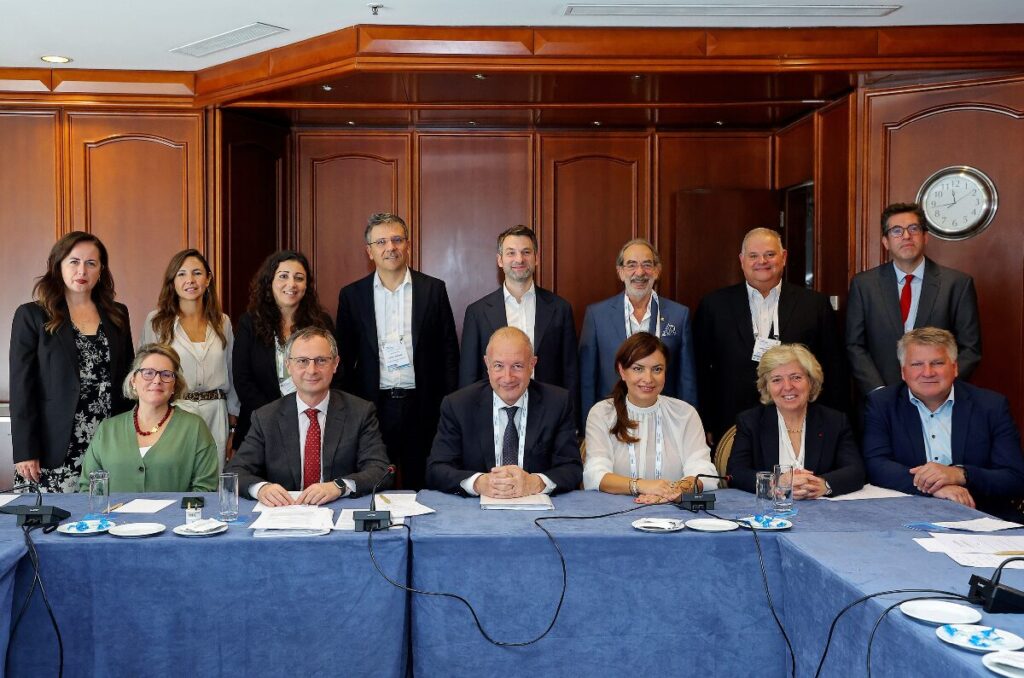
SEV Highlights Key Competitiveness Priorities at BusinessEurope’s Council of Presidents in Cyprus
On 20-21 November, the President of SEV’s Executive Committee, Mrs. Rania Aikaterinari, participated at BusinessEurope’s meeting of Presidents. BusinessEurope represents more than 25 million companies through 42 national federations from 36 countries from the EU and neighbouring countries.
The meeting took place in Nicosia ahead of the Cyprus Presidency of the EU in January 2026. Key messages we raised included:
- Europe needs agility, speed and unity to remain relevant and impactful. Economic and geopolitical strength must go hand in hand.
- Stronger dialogue between policymakers and industry is necessary in order to remain true to European values and goals towards a carbon neutral continent that does not threaten our social and economic fabric.
- Europe needs a cultural shift, from the existing overregulation mindset to rewarding business ambition and giving space to entrepreneurs to innovate and grow, without being trapped in a costly and time-consuming bureaucracy
- Although the regulatory simplification agenda is moving forward (Omnibus I package on CSRD /CSDDD on 13 November and the new digital omnibus announced last week), many pressing issues remain open.
- High energy costs is the most critical among them. Without competitive energy prices, we risk losing more investments and may witness further de-industrialisation. Data shows that investments in Europe decreased by almost 2% in 2024 compared to 2023. Many Member States are attempting to support and protect their industries but need further support from the EU, together with concrete action to promote a true Energy Union.
- The deepening of the single market remains limited, with persisting barriers to goods and services which translate into significant internal tariffs: almost 45% for goods and over 100% for services. Although discussions on the savings and investment union have begun, tangible results will take time.
- The negotiations for the next EU budget 2028-2034, are critically important. Member States must find the right balance between traditional policies, such as cohesion and agriculture, with new priorities such as defense and competitiveness.
- For Mediterranean countries, and the employer organisations of the MED9 cooperation framework, increasing productivity is key prerequisite for growth and increasing wages. Also, more attention should be given to demographic challenges and affordable housing
- We welcome the priorities of the Cyprus Presidency and focus on the blue economy agenda which accounts for 5 million jobs in the EU and represents a gross value added of € 250 bn. This will include actions to stimulate sectors such as fisheries, aquaculture, shipping and energy as well to strengthen security at sea, e.g. submarine cables.
The Declaration of the Nicosia Council of Presidents is available here
BusinessEurope Economic Outlook Autumn 2019 – EU economy weakens as trade tensions continue
The EU economy is experiencing an economic slowdown, reflecting declining global demand and uncertainties due to trade tensions. We forecast 1.3% real GDP growth in 2019 for the EU28 and 1.2% in 2020. This entails a significant downwards revision from our spring forecast released half a year ago (down from 1.6% for 2019 and 1.7% for 2020).
As a consequence of trade tensions, European manufacturing output is down around 2% from its peak two years ago. Whilst strong wage rises and increasing employment are supporting domestic consumption, this is likely to fall as consumers become more cautious, acting as a brake on service sector growth.
Substantial risks to the economic outlook are concentrated on the downside due to the potential for escalation of trade tensions between both the USA and China and the USA and the EU, which would impact negatively on business, and the uncertainties that persist around a possible no-deal Brexit.
The outlook also takes stock of the difficulty of hiring specialists with skills in information and communication technology that many businesses experience. It concludes that whilst there is evidence that companies are increasing wages considerably for professions where shortages are most acute, we need a response from the educational system to address growing skills imbalances.
Economic prospects weaken as coronavirus forges ahead… – SEV’s monthly economic bulletin
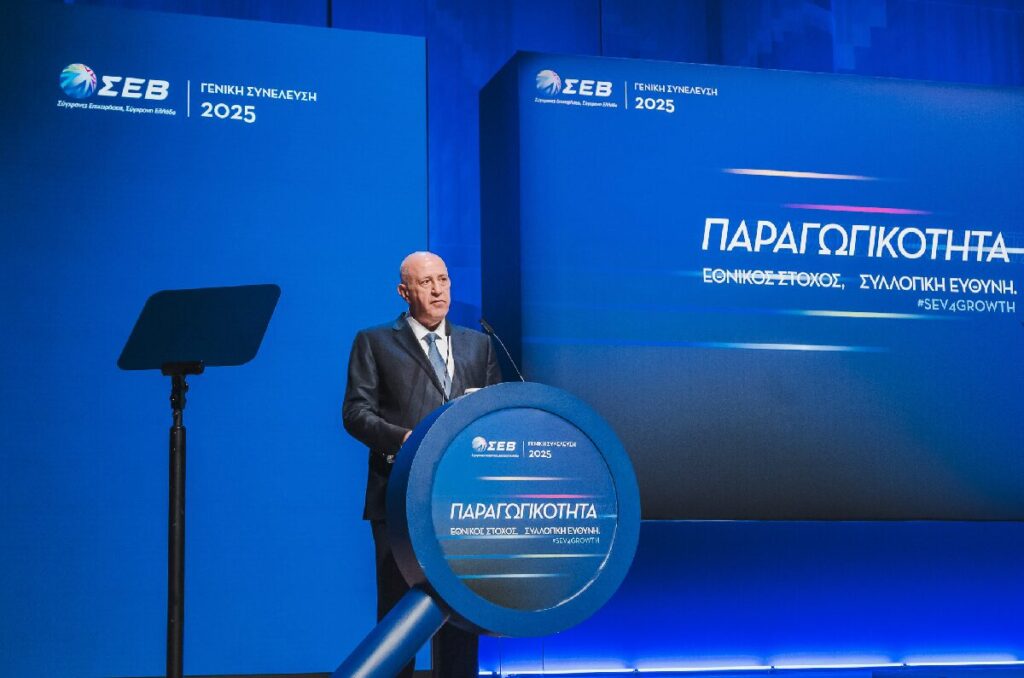
Spyros Theodoropoulos at SEV’s General Assembly: Productivity – A National Goal for Greece
- “Productivity is the only path to competitiveness, growth, and social prosperity.”
- “State, business, and society must commit to this national goal with consensus and without toxicity.”
- “The goal is not to work more, but to work better and more efficiently.”
- “Energy costs remain a matter of survival for Greece’s productive base — we expect solutions through dialogue with the Government.”
With the key message “Rising Productivity: A National Imperative, A Shared Responsibility” (#SEV4Growth), SEV held today, Tuesday, October 7th, 2025, the Open Session of its Annual General Assembly at the Athens Concert Hall, in the presence of the President of the Hellenic Republic.
Prime Minister Kyriakos Mitsotakis delivered a keynote address, while SEV’s Chairman Spyros Theodoropoulos presented the business community’s proposals to boost productivity as the key to a more competitive economy and a more prosperous society.
Guest of honor was Dr Joachim Nagel, President of the Deutsche Bundesbank and Member of the General Council of the European Central Bank, who engaged in a discussion with journalist Pavlos Tsimas. In his opening remarks, Dr Nagel emphasized: “What Greece has achieved over the past decade is not only a national success story – it is an inspiration for all of Europe. It shows that reform, though challenging, does pay off.”
In his speech, SEV’s Chairman Theodoropoulos highlighted that the global environment is marked by turbulence and unprecedented uncertainty, with effects on trade, energy, and supply chains. At the same time, Europe is lagging in growth, productivity, and technological progress compared to the U.S., China, and India. One year after the Draghi Report, only 11% of its recommendations have been implemented, reflecting Europe’s slow response.
Within this context, he noted that Greece has achieved significant progress and gradual convergence: steady growth rates above the EU average, restoration of investment-grade status, reduced tax evasion, a sharp drop in unemployment, wage increases, and lower tax rates for low and middle incomes. As he stated, “Greece has managed to function as a normal country — one that lives within its means and does not burden future generations.”
Mr. Theodoropoulos underscored the contribution of businesses — led by industry — to Greece’s strong economic performance. He pointed out that total exports of goods reached €50 billion in 2024, matching for yet another year the revenues from tourism and other exported services. Industry, the country’s second-largest employer after trade, offers wages 35% higher than the national average, while sectors such as food, pharmaceuticals, metals, chemicals, and ship equipment continue to expand their global footprint. He also acknowledged the contribution of other sectors to GDP and praised the innovation ecosystem, which is growing rapidly, with 3,000 startups and an estimated total valuation of $8–12 billion in 2024.
However, he stressed that critical gaps remain compared to Europe — including the trade deficit in goods, high and volatile energy costs, excessive regulation, bureaucracy, and slow judicial processes.
At the heart of his address was the issue of low productivity. Greece, he noted, stands at 54% of the EU average (with industry at 75%) and has remained nearly stagnant for three decades. He referred to a “widespread misconception in parts of society that improving productivity means working longer hours or intensifying labor,” clarifying instead that “Productivity is about creating added value. It depends on organization, technology, investment, institutional simplification, the speed of justice, the quality of education and training at all levels, functional infrastructure, and regulatory stability.”
He emphasized that responsibility for increasing productivity lies primarily with the State and businesses, not workers, and called on all parties “to set a common goal of rapidly increasing productivity across every aspect of public and private sector activity — with annual milestones, measurable indicators, and regular accountability.”
Mr. Theodoropoulos urged both the State and enterprises to make a leap in productive investment, which, he said, would in turn trigger leaps in export orientation, technology, and industrial renewal. He reiterated SEV’s proposal to institutionalize super-deductions as a horizontal investment incentive.
He also identified human capital as a critical priority, stressing the need for large-scale investment in technical and vocational education, training and reskilling, adoption of Artificial Intelligence by businesses, and stronger inclusion in the labor market.
On energy costs, the SEV Chairman reiterated that they remain a decisive factor for Greece’s competitiveness. He emphasized that the country continues to rank among those with the highest energy prices in the EU, undermining competitiveness across sectors and fueling inflation. For industry — particularly energy-intensive sectors — access to competitive and predictable energy is a matter of survival. He expressed hope that the ongoing dialogue between SEV and the Government will soon lead to concrete results supporting domestic production.
Concluding his speech, he called for cooperation “to move from individual effort to collective endeavor” and “to transform Greece from a ‘normal’ country into a productive one.”
He urged the State “to make productivity a core criterion of all public policies” and businesses “to intensify their investment, digitalization, export efforts, and people development.” Finally, he reassured society that improving productivity is “the path to better jobs, higher wages, and stronger social services — not a Trojan horse for work intensification.”
GOLD SPONSORS
ALPHA BANK
JTI Hellas
ION S.A. Cocoa & Chocolate Manufacturers
SILVER SPONSORS
ACCENTURE
AEGEAN
ELVALHALCOR S.A. (ElvalHalcor)
HELLENiQ ENERGY Holdings SA
METRO S.A.
MOTOR OIL (HELLAS) CORINTH REFINERIES S.A.
Olympia Group
Quest Holdings
TITAN Group
UNI-PHARMA S.A.
BRONZE SPONSORS
ELVIAL S.A.
People for Business
PUBLIC POWER CORPORATION S.A.
SPONSORS
ABB SA
ATHENS INTERNATIONAL AIRPORT S.A.
BAT Hellas
Big Pi Ventures
Coca-Cola Hellas
DEMO SA
DIADIKASIA BUSINESS CONSULTING S.A.
DIS – Dynamic Integrated Solutions
ELPEN S.A.
Goldair Cargo
HEDNO S.A. Hellenic Electricity Distribution Network Operator S.A.
Hellas Gold
HELLENIC DUTY FREE SHOPS
HELLENIC HYPERMARKETS SKLAVENITIS S.A.
IMERYS Greece S.A.
METLEN – Energy & Metals
NN Hellas
PAPASTRATOS
PIRAEUS
SAP Hellas Single-Member S.A.
TEMES
KAFKAS SA ELECTRICAL & LIGHTING EQUIPMENT WHOLESALER
YIOTIS S.A.
Step up changes for faster growth!– SEV’s monthly economic bulletin
EU should rebalance trade and become climate neutral
European business presents its new energy and climate and trade strategies –
Today, BusinessEurope published its two new strategy papers on energy and climate policies and on trade policy, proposing adjustments to current EU policies.
BusinessEurope Director General Markus J. Beyrer said: “The European business community stands behind the EU ambition to achieve net-zero greenhouse gas emissions to achieve the goals of the Paris Agreement. Today businesses are making huge investments and are ready to engage with governments and society to reach this objective of climate neutrality. Whether climate neutrality is possible by around mid-century in order to limit global average temperature increases to 1.5°C will depend on meeting a set of crucial framework conditions and actions. This means Europe needs a comprehensive industrial strategy for investments, large-scale availability of affordable low-carbon energy, full participation of its citizens and a rapid convergence of global actions. In global trade today, we are confronted with protectionism, increasing uncertainty and mounting pressure on the multilateral trading system. That’s why European businesses want an EU trade strategy that is open, rules-based and better enforced. Our top priorities are rebalancing the EU relations with China and the US, promoting a reformed and more effective World Trade Organisation and pursuing ambitious trade and investment negotiations that restore the level playing field for European companies while allowing more people to benefit from trade.”
Please see a short video statement and read:
A trade strategy fit for the 21st century
European business views on a competitive energy & climate strategy