Protecting the EU economy against extraterritorial sanctions

Key messages

  • Business opposes the weaponisation of the sanctions policy and the use of such measures to pursue economic interests. Sanctions are designed specifically to enforce the respect of international law to counter fundamental threats to peace and stability and the protection of human rights and must be limited to these core purposes.
  • We welcome the political attention to this matter and support a more assertive approach by the EU to protect its sovereignty in economic diplomacy. Unilateral measures that risk escalation with third countries should remain an option of last resort and multilateral approaches should be actively sought where possible. Especially with the USA as our traditional ally, the main aim must remain to achieve alignment on sanctions policies and implementation. A close cooperation regarding sanctions should also be established with the UK as part of the future relation.
  • The aim must be to deter harmful action by third countries and, if necessary, to increase the costs for such harmful action. To do so, the toolbox needs to be better equipped with well-targeted, non-discriminatory, and well workable and implementable solutions. In the current absence of an effective mechanism, EU companies are caught between a rock and a hard place.
  • The EU, together with its allies, should take international leadership on this issue leveraging on its economic and political weight. The EU should insist on a multilateral strategy as this will increase the political strength of the argument.

Read our position paper: Recommendations to strengthen the EU foreign economic diplomacy in the area of sanctions

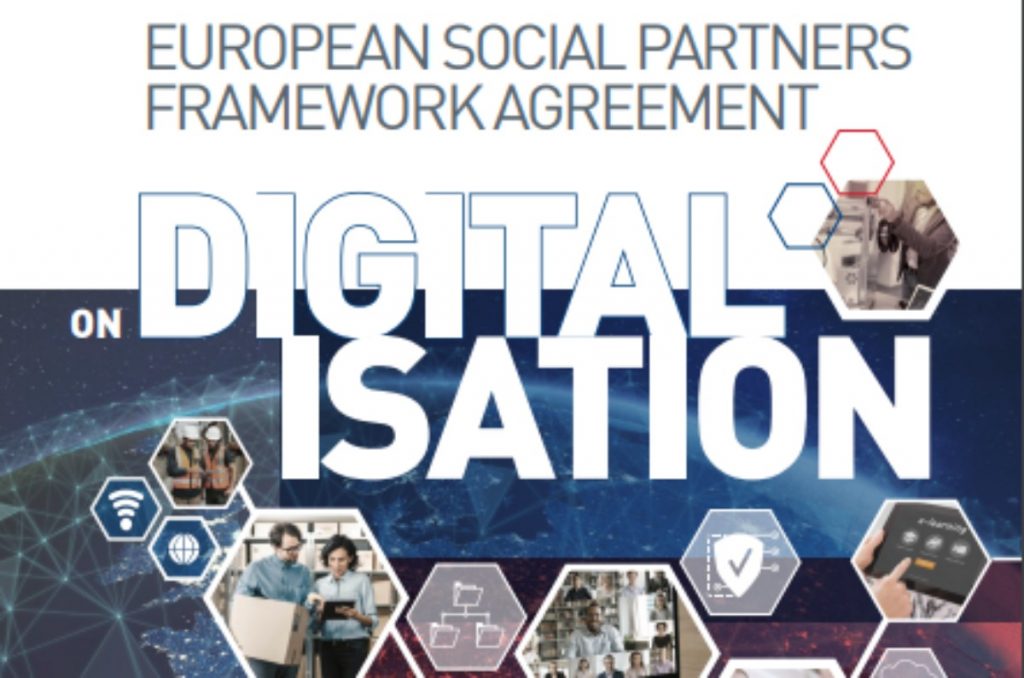
European social partners framework agreement on digitalisation

The digital transformation of the economy is a multifaceted topic with large implications for labour markets, the world of work and society at large. It is dealt with in a variety of ways by EU member states, due to different social and economic situations, labour markets and industrial relations systems and existing initiatives, practices and collective agreements.

The digital transformation brings clear benefits for employers, workers and jobseekers alike, in terms of new job opportunities, increased productivity, improvements in working conditions and new ways of organising work and improved quality of services and products. Overall, with the right strategies, it can lead to employment growth and job retention.

The transition also comes with challenges and risks for workers and enterprises, as some tasks will disappear and many others will change. This requires the anticipation of change, the delivery of skills needed for workers and enterprises to succeed in the digital age. Others include work organisation and working conditions, work life balance and accessibility of technology, including infrastructure, across the economy and regions. Specific approaches are also needed for SMEs to embrace digitalisation in a way that is tailored to their specific circumstances.

Since the gains are not automatic, we need to adapt our labour markets, education and training, and social protection systems to make sure the transition is mutually beneficial for employers and workers. The EU and national governments have an important role to play, by ensuring that the framework conditions allow and support employers and workers to grasp the opportunities and leave them space to find appropriate solutions to deal with the challenges, bearing in mind that they know best the situation on the ground and what measures are needed to benefit enterprises and workers.

It is also important to take into account the climate and environmental impacts.

Furthermore, a shared commitment is needed on the part of employers, workers and their representatives to make the most of the opportunities and deal with the challenges in a partnership approach, whilst respecting the different roles of those involved.

This framework agreement is the shared commitment of the European cross-sectoral social partners – BusinessEurope, SMEunited, CEEP and the ETUC (and the liaison committee EUROCADRES/ CEC) – to optimise the benefits and deal with the challenges of digitalisation in the world of work.

Aims
This framework agreement aims to:

  • Raise awareness and improve understanding of employers, workers and their representatives of the opportunities and challenges in the world of work resulting from the digital transformation;
  • Provide an action-oriented framework to encourage, guide and assist employers, workers and their representatives in devising measures and actions aimed at reaping these opportunities and dealing with the challenges, whilst taking into account existing initiatives, practices and collective agreements;
  • Encourage a partnership approach between employers, workers and their representatives;
  • Support development of a human-oriented approach to integration of digital technology in the world of work, to support/assist workers and enhance productivity;
    By:

Outlining a joint dynamic circular process, which takes into account the different roles and responsibilities of the different actors and can be tailored to different national, sectoral and/ or enterprise situations, industrial relations systems, jobs and different digital technologies/tools;
Highlighting concrete approaches, actions and measures, which employers, workers and their representatives can use, according to their specific needs and circumstances, to tackle topics such as skills, work organisation and working conditions.

European business sets priorities for the future EU-UK relationship

Negotiators need to work towards an agreement that works for business

Today, BusinessEurope published its position paper on the future EU-UK relations. European business wants to maintain strong economic ties and keep a close economic relationship while preserving the integrity of the Single Market.

BusinessEurope Director General Markus J. Beyrer said: “EU-UK trade must remain tariff and quota free and non-tariff barriers must be minimised. We also need ambitious provisions covering among others trade in services, investment, data flows and government procurement. Divergence in rules should be avoided to maintain barrier-free trade. Continuous regulatory cooperation and mutual recognition will be crucial to mitigate disruption also in the long term.”

He added: “European business is ready to play an active role during the negotiations. We expect a high level of ambition on both sides but there is limited time to achieve a comprehensive EU-UK trade agreement. Therefore, the transition period needs to be used efficiently in order to finalise, ratify and implement the agreement in time. But if it becomes evident that the time available does not suffice, both sides should be open to finding pragmatic solutions that prevent cliff edge by the end of 2020.”

Read our position paper on the EU-UK future relationship

EU should fundamentally rebalance its relationship with China

Systemic challenge and market-distorting practices must be addressed
Today, BusinessEurope published its key strategy paper on the EU’s economic relationship with China. European business wants to build a stronger and fairer economic relationship, but systemic challenges prevent European companies from untapping this economic potential. The obstacles created by China’s state-led economy lead to market distortions in China, in the EU and in third countries. We call on the EU to reconsider how it engages with China, so that it can seize the opportunities and mitigate the distortions and challenges created by China’s state-led economy.

BusinessEurope President Pierre Gattaz said: “China and Europe have benefitted tremendously from China’s accession to the WTO in 2001. But in recent years, the consolidation of China’s state-led economy over market-oriented reforms and the difficulty in achieving much needed WTO reform have led to an imbalance in the global level playing field.”

BusinessEurope Director General Markus J. Beyrer said: “There is today a renewed sense of urgency among the European business community: the systemic challenge posed by China’s market-distorting practices cannot remain unaddressed. The EU should rethink how it engages with China, with a view to securing a stronger and fairer economic relationship and levelling the playing field.”
In order to rebalance the economic relationship towards a stronger and fairer one, BusinessEurope advances four key objectives for the EU to pursue:

  1. Secure a level playing field between China and the EU;
  2. Mitigate the impact of China’s government-induced market distortions;
  3. Reinforce the EU’s own competitiveness;
  4. Ensure fair competition and cooperation on third markets.
  5. To achieve these four objectives, the paper lists 130 recommendations to authorities in the EU and its Member States.

    Read our strategy on rebalancing the EU-China relationship here.
    Read also the executive summary in English here, in Chinese (Mandarin) here.

Business Environment


Business Environment

For SEV, the ultimate goal is to ensure a level playing field for all businesses and to attract investment. To this end, SEV promotes policy proposals and evidence-based positions aimed at shaping a business-friendly environment, free from unnecessary administrative burdens, with clear, predictable, and stable rules that strengthen legal certainty and promote transparency.

Licensing: The simplification and modernisation of licensing procedures is a critical factor for increasing the country’s productivity and attracting investment. Our focus areas are:

  • Ensuring the smooth transition of businesses to the new landscape created by changes in the regulatory framework (notification and approval framework for establishment/operation, new standard environmental commitments, new licensing and inspection information system “OpenBusiness”, etc.)
  • Extending the modern licensing system for establishment and operation to a wider range of economic activities
  • Leveraging modern digital tools and processes to handle all stages of licensing, establishment, operation and inspections
  • Regulatory framework for the development of cutting-edge activities and new technologies
  • Exploring new innovative regulatory tools for the future of licensing legislation based on modern European best practices (regulatory sandboxes)
  • Steady improvement of the country’s ranking in the World Bank’s Business Ready (B-READY) index
  • Modernisation of the licensing regulatory framework and legal certainty for major productive installations contributing to export growth and the strengthening of the country’s geostrategic position
  • Continuous monitoring and evaluation of the implementation of reforms

Spatial Planning: Over the past fifteen years, significant progress has been made in Spatial Planning with the first Special Spatial Frameworks for Industry and Renewable Energy Sources (2008–09) and the Revisions of Regional Spatial Frameworks (2018–21). These have undoubtedly supported businesses of all sizes, which legitimately seek legal certainty, compatible land uses and building conditions, modern infrastructure networks and competitive spatial organisation conditions, in order to proceed swiftly and with confidence in implementing their investments. The country still falls short of the planning and spatial programming standards of other European states. The priorities for modernising Spatial and Urban Planning Policy are identified in the following actions:

  • Strengthening legal certainty at all stages of the investment journey
  • Increasing the country’s investment attractiveness in terms of transparency
  • Improving the coordination of policies with spatial impact
  • Safeguarding public and private interests in the siting of projects and activities of all scales
  • Accelerating and simplifying planning, siting and licensing procedures
  • Specifying appropriate land uses and spatial development conditions compatible with the particular needs of business and manufacturing activities
  • Introducing a framework for the organisation of maritime productive activities
  • Increasing the degree of implementation, effectiveness and flexibility of planning
  • Balanced, sustainable and inclusive spatial development to strengthen national and European territorial cohesion
  • Promoting participatory approaches in the planning of the business and productive base
  • Integrating the climate change dimension into spatial planning
  • Aligning the national planning system with international and European best practices
  • Improving the urban environment and quality of life in cities

Easy procedures for business formation, operation and closure: We promote the “digital by default” and “once only” principles, so that procedures covering all stages of a business lifecycle are carried out swiftly and easily through electronic services (e.g. GEMI, One-Stop Services, Tax Registry, etc.).

Faster administration of justice: Our objective is to accelerate judicial proceedings so that court decisions are not delayed, legal certainty is strengthened, fair competition is protected and investment is facilitated.

Business-friendly public procurement framework: Our goal is to ensure an effective and transparent framework for public procurement, with swift tendering procedures and fair conditions for participation.

Licensing: SEV continues to work towards the further simplification of licensing procedures and collaborates with public administration to achieve the expected outcomes and ensure a visible reduction in the administrative burden on businesses. At the same time, SEV keeps business associations informed of ongoing changes and their impact on procedures for establishing, modernising, expanding and renewing licences. In this context, the most significant proposals for the current period include the following:

  • Rationalisation and modernisation of procedures for the establishment and operation of economic activities not yet covered by the provisions of Law 4442/2016
  • Alignment of the Renewable Energy Sources licensing framework with current European legislation (RED III Directive)
  • Extension of interoperability and ensuring adequate connectivity with other digital platforms and registries
  • Alignment of the national licensing framework with its European counterpart to support and attract new energy activities (e.g. offshore RES and hydrogen technologies for industry)
  • Legislative improvements and promotion of the issuance of secondary legislation under Law 2971/2001 to modernise the licensing framework for port facilities serving industrial and related activities
  • Evaluation of the implementation and impact of Law 4442/2016 on improving the business environment and business start-up (Ex-post Impact Assessment of Law 4442/2016)
  • Investigation of issues arising from the implementation of the new fire protection regulatory framework (Presidential Decree 41/2018) and formulation of resolution proposals

Spatial Planning:

  • Preparation of a National Spatial Strategy to better coordinate all policies with spatial impact and to set directions and objectives for spatial organisation and development over the medium and long term
  • Evaluation and revision of the Special Spatial Frameworks for Industry (2009), Renewable Energy Sources (2008) and Aquaculture (2011), alongside the preparation of new frameworks (Mineral Raw Materials, Networks and Technical and Administrative Infrastructure Services) to provide modern development guidance and regulations in sectors of national importance
  • Preparation of an initial maritime spatial plan and gradual institutionalisation of Maritime Spatial Frameworks
  • Ensuring a flexible and modern land use and building conditions framework, adapted to the contemporary needs of productive installations, within the context of Local Urban Planning Schemes
  • Modernisation of the Athens-Attica Regulatory Plan to adapt planning to contemporary development and spatial challenges
  • Support for structures that accelerate and improve planning effectiveness (including: KESYCHOTHA for conflicts and contradictory provisions across planning levels, YDOM for large investments, and the institution of private evaluators for spatial studies)
  • Modernisation of urban regeneration policy and introduction of incentive policies for the reuse of vacant industrial buildings
  • Horizontal resolution of land use issues for productive activities making a significant contribution to national economic development
  • Integration and specification within spatial policy of a national network for the development of port facilities for industrial and related activities
  • Development of the National Geospatial Information Infrastructure (EUGEPI) and activation of the Unified Digital Map to accelerate licensing with legal certainty
  • Implementation of the Digital Land Bank and designation of Transfer Coefficient Reception Zones to activate the transfer of building coefficients
  • Introduction of a Multi-level Consultation Mechanism to ensure participatory planning

Interconnection of registries and information systems across all stages of a business lifecycle: We systematically promote the continuous improvement of services provided by GEMI to businesses, with particular emphasis on its interconnection with other public registries as well as the registries of commercial banks.

Faster administration of justice: We support the digitalisation of judicial proceedings, electronic case management across all courts and the use of artificial intelligence. We seek to further promote alternative dispute resolution methods and highlight the need for continuous and targeted training of judges on business-related cases.

Simplification of the public procurement framework: We advance proposals for the further simplification of European and national public procurement legislation and the procedures governing it, the use of digital tools and artificial intelligence tools at all stages of tendering procedures, as well as the delivery of continuous training to contracting authorities.

  • Licensing, Spatial Planning & Infrastructure Committee: The Committee serves as the technical advisory body of the SEV Board in the formulation, substantiation and consultation of policy positions and proposals with public administration and other competent authorities. Its objective is to improve the investment environment through the modernisation and simplification of business start-up and operating procedures, the advancement of proposals to reduce administrative burdens and licensing costs, as well as the prompt integration of all technological and related developments into the relevant procedures. In this context, the Committee records, monitors and evaluates the implementation of legislative initiatives, promotes the alignment of the national framework with European best practices and contributes to the coordination of policies to resolve sector-specific licensing issues (in collaboration with the relevant SEV Committees and the SEV Council for Sustainable Development). Particular emphasis is placed on the role of infrastructure and transport in the productive functioning of the economy. The Committee elaborates proposals for the development and interconnection of transport infrastructure, logistics networks and the country’s trade gateways, with the aim of ensuring the efficient flow of goods between industrial clusters, distribution centres (B2B and B2C), ports and international transport networks.
  • Market Operation & Consumer Committee: The Committee serves as the technical advisory body of the SEV Board in the formulation, substantiation and consultation of policy positions and proposals with public administration or other competent authorities, on matters relating to Consumer Protection, Competition, Market Surveillance, Quality Policy and Public Procurement.

CONTACT PERSON

Michael Mitsopoulos
Director, Business Licensing, Spatial Planning & Infrastructure

Email me

CONTACT PERSON

Ioannis Lainas 
Senior Advisor, Business Licensing, Spatial Planning & Infrastructure

Email me

CONTACT PERSON

Avgi Oikonomidou
Senior Advisor, Tax, Investments & Market Operation

Email me


Related

COVID-19: EU institutions and member states must support and protect businesses and workers

The European business community fully supports the measures taken so far and calls on the European Commission, the Council and the European Central Bank to do whatever it takes to make sure that as many businesses as possible survive this crisis and can help rebuild our economy and protect our European way of life once the health crisis caused by COVID-19 is overcome.

We support the measures necessary to contain the further spreading of COVID-19. Public health is the first priority. Our sympathies are with the families already affected. We express our gratitude to the workers and businesses who are showing exceptional courage and resilience, both to treat the sick and to maintain the vital goods and services we all depend upon.

This crisis is not only a major challenge for public health but will also have substantial negative impact on EU growth in 2020, with the likelihood of a large number of EU member states experiencing a significant or in some cases even massive downturn. Workers and companies, especially SMEs, are already suffering dramatically from the necessary restrictive measures which have been put in place.

Protecting our society will require extraordinary responsibility, action and solidarity from all parties, said Markus J. Beyrer, Director General of BusinessEurope:

  • Responsibility as businesses, workers and citizens, to ensure everything we do helps address this crisis.
  • Action, both to maintain the essential functioning of our economy in the immediate future and to ensure that once the spread of the virus is addressed, we have maintained the business eco-system vital to fully restoring our treasured European way of life.
  • Solidarity between businesses of all sizes, between businesses and governments and between all EU member states.

Collapse of WTO Appellate Body: BusinessEurope Council of Presidents calls for urgent action

Today, BusinessEurope, the umbrella organisation for the leading national business and employers’ federations of 35 European countries calls for urgent action to save the WTO Appellate Body. In Zagreb, BusinessEurope’s Council of Presidents of national member federations met and sent a strong warning, speaking on behalf of around 20 million small, medium and large companies throughout Europe.

Today, BusinessEurope, the umbrella organisation for the leading national business and employers’ federations of 35 European countries calls for urgent action to save the WTO Appellate Body. In Zagreb, BusinessEurope’s Council of Presidents of national member federations met and sent a strong warning, speaking on behalf of around 20 million small, medium and large companies throughout Europe.

BusinessEurope President Pierre Gattaz said:

“We see rising protectionism and unilateralism as serious threats to sustainable economic growth. The World Trade Organisation (WTO) has been ensuring, since its creation in 1995, that countries around the world respect the rules of the game.

Countries were able to settle disputes in an orderly way through the WTO independent dispute settlement system that includes an Appellate Body. The Appellate Body will be paralysed by next week, leaving the whole dispute settlement system in the verge of collapse in a moment when trade disputes are increasing.

“The current system has provided massive benefits to business and consumers and is an essential element of the WTO. It is not perfect and needs substantial reform, but instead of destroying what we have, we need to agree on improving it. Behind every trade dispute there are companies that rely on clear, stable and enforceable rules. Therefore, we ask all WTO members to act responsibly and find a solution that can prevent the law of the jungle in international trade.

Until an agreement in the WTO is reached, countries should also look at alternative dispute settlement solutions, as the European Commission is currently proposing”.