SEV Annual General Assembly held under the key message “A Productive Greece in a Changing Europe”
The Federation’s members renewed their confidence in Mr Spyros Theodoropoulos, re-electing him as Chairman for the 2026–2028 term
A new Board of Directors and General Council were also elected.
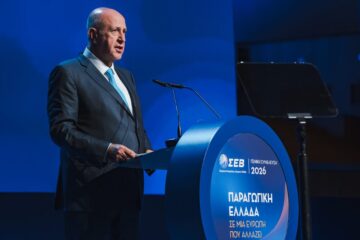
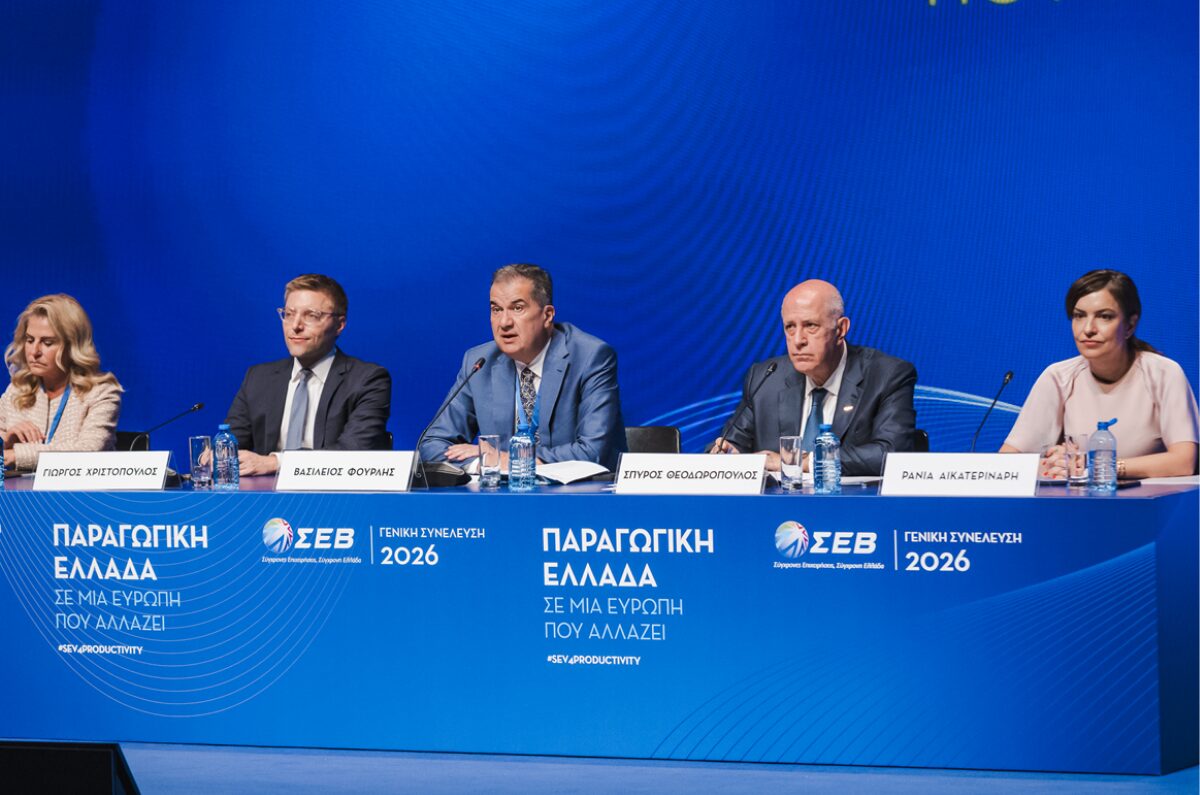
Under the key message “A Productive Greece in a Changing Europe” #SEV4Productivity, SEV’s Annual General Assembly was held today, Tuesday, 16 June 2026, at the Athens Concert Hall.
At this year’s General Assembly, the Federation’s Members elected Mr Spyros Theodoropoulos as Chairman of the Board of Directors, while the other members elected to the new Board are:
Vice-Chairs: Rania Ekaterinari, Andreas Shiamishis, Vassilios Psaltis
Secretary General: Alexandra Papalexopoulou
Treasurer: Marko Veremis
Members:
Olga Vagena
Kallinikos Kallinikos
Naya Kalogeraki
Ioannis Karagiannis
Nikolaos Kafkas
Alexandros Kikizas
Achilles V. Constantakopoulos
Nikolaos Loulis
Philippa Michali
Aristotelis Panteliadis
Kyriacos Sabatakakis
Menelaos Tasopoulos
Theodoros Tryfon
Evangelos Chrysafis
A new General Council was also elected at today’s General Assembly, representing the full spectrum of businesses and some of the most dynamic sectors of the Greek economy.
In his customary address to SEV Members, Chairman of the Board of Directors, Mr Spyros Theodoropoulos, noted, among other things:
- “Despite the progress made in recent years, energy costs in Greece remain significantly higher than in competing countries in the region. Today, there is greater scope for national-level interventions, and we must make full use of it.”
- “Further reducing non-wage labour costs, enhancing labour market flexibility and shaping collective agreements that take into account business productivity and competitiveness remain among our key priorities.”
- “A major effort was made in spatial planning to ensure sufficient space for the industry of the future. The country needs clear rules, legal certainty and room for productive investment to grow.”
- “We need a more effective framework for flagship and strategic investments, with clear criteria, faster procedures and sufficient resources to provide meaningful support for the productive transformation of the economy.”
- “Enhanced depreciation allowances can be one of the most effective tools for boosting investment, as they enable businesses to implement their investment plans quickly and without unnecessary bureaucracy.”
- “The defence industry is creating significant new opportunities for Greek production. SEV will continue to support every initiative that strengthens the participation of Greek businesses in the new European value chains.”
- “Artificial intelligence is perhaps the greatest challenge, but also the greatest opportunity, facing businesses. Despite the progress made, the majority of Greek businesses still believe that it does not yet concern them. This must change.”
- “Increasing the size of businesses is a prerequisite for higher productivity, better wages and stronger competitiveness. The country needs more partnerships, mergers and incentives for business consolidation.”
- “Europe is facing critical decisions regarding its new multiannual budget. Greece must prepare in good time and actively contribute to shaping policies that support competitiveness, investment and growth.”
- “Productivity is the single most important challenge facing the Greek economy. It is the prerequisite for more investment, higher wages and genuine convergence with Europe.”
President of the Executive Committee and Vice Chair of the Board of Directors of SEV, Ms Rania Ekaterinari, emphasised SEV’s role as a social partner, its initiatives to support businesses and industry, and the strengthening of the Association’s European presence at a time when major decisions concerning the competitiveness of European businesses are imminent.
Special reference was made to the signing of the National Social Agreement to strengthen collective labour agreements, which creates a more modern and functional framework for social dialogue, with more effective mechanisms for resolving collective disputes.
Referring to industry, she stressed that strengthening the sector remains a strategic priority for SEV, through interventions aimed at reducing energy costs, enhancing investment incentives, simplifying the business environment, and shaping the new Spatial Planning Framework for Industry and Logistics with legal certainty.
She also referred to SEV’s initiatives for skills development, focusing on the new SEV Technical Academy, the “MAZI STI GNOSI” training programmes and the GenAI Bootcamps digital workshops for executives of SEV member companies. She also highlighted the Association’s interventions in research, innovation and the defence industry, in view of the major changes taking place at European level.
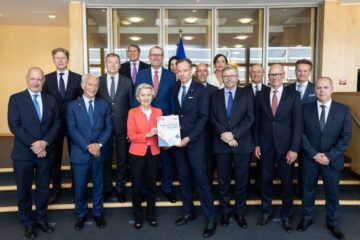
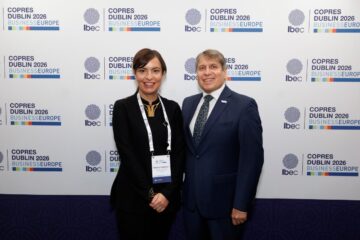
Particular emphasis was placed on SEV’s steadily growing presence in Europe, primarily through BusinessEurope, as well as through the MED9 initiative, a cooperation framework among Mediterranean EU countries aimed at developing common positions on the EU’s next budget.
Finally, she presented SEV’s initiatives to promote artificial intelligence and digital transformation, support start-ups and scale-ups, and strengthen the international orientation of Greek businesses.
In closing, she underscored the importance of increasing productivity in Greece, “because productivity is not just another economic indicator; it is the foundation on which investment, competitiveness, better pay and, ultimately, the country’s sustainable growth are built.”
Mr Vassilis Fourlis, Chairman of the Board of FOURLIS HOLDINGS S.A., was elected Chair of this year’s SEV General Meeting. In his opening remarks, he noted, among other things:
“We meet at a time when the global economy and the business environment are undergoing continuous transition. Geopolitical tensions, shifts in value chains, accelerating technological change and the need for sustainable growth are creating a landscape of heightened uncertainty, but also significant opportunities. In this environment, the role of organised business becomes more critical than ever. SEV is called upon to act not only as the representative of businesses, but also as an institutional interlocutor with the State and society, contributing to the shaping of policies that strengthen competitiveness, innovation and the country’s long-term growth. This responsibility is a collective one and requires seriousness, evidence-based analysis and a willingness to build consensus.”
Chief Executive Officer, Executive Board Member, HELLENiQ ENERGY Holdings S.A. and SEV’s Vice President, Mr Andreas Shiamishis, noted:
“After many years, we once again faced the risk of fuel shortages as a result of geopolitical developments. The existence of modern and flexible industrial facilities gave our country a competitive advantage in terms of security of supply as well as pre-tax prices, demonstrating in the clearest possible way the value of maintaining and expanding industrial infrastructure in Greece and across Europe. Consumers worldwide were faced with higher energy costs, on top of the significant cost of the energy transition, which Europe had underestimated. In electricity, major investments in renewable energy sources reduced dependence and crisis-related costs, but system stability still requires a significant contribution from natural gas. Support for consumers and the market was important, but not sufficient to offset the increased costs. Greater efforts are required in terms of support, regulatory stability and recognition of the real cost of the transition through targeted incentives.”
TITAN S.A. Executive Board Member and SEV’s Board General Secretary, Ms Alexandra Papalexopoulou, stressed:
“European leadership has now clearly recognised that strengthening competitiveness is a central priority for the future of the European economy and is moving in the right direction through a series of important initiatives. Greater flexibility in State aid rules, investment in energy grids, simplification of the regulatory framework and new industrial policy initiatives, such as the Industrial Accelerator Act, constitute meaningful steps towards supporting production, investment and Europe’s industrial base. At the same time, efforts to reduce bureaucracy through the Omnibus packages and accelerate free trade agreements point to a more pragmatic approach that combines the green transition with economic growth. For Greece, these developments create significant opportunities for industry, exports and investment attraction. The challenge now lies not only in designing the right policies, but also in implementing them swiftly and effectively, so that Europe and Greece can strengthen their position in an increasingly competitive international environment.”
Alpha Bank Group CEO and SEV Board Member, Mr Vassilios Psaltis, noted:
“Through the two Recovery Fund programmes, and with the support of banks that provided €8.8 billion in loans, investment plans worth €27.5 billion were implemented, placing Greece among the leading countries in Europe in terms of fund absorption. This is a significant achievement and, at the same time, sets the benchmark for the next step. The key structural issue, however, remains productivity: we work the longest hours in the EU, 39.6 compared with the European average of 35.7, yet output per employee reaches only 55% of that level. Addressing this requires three interventions: a. directing financing towards investments that increase productivity and competitiveness; b. stronger incentives for the technological modernisation and scaling-up of Greek businesses; c. mobilising savings, including through occupational pension funds, to support investment in the Greek economy. Today, Greece has something it lacked for many years: credibility. It is a valuable and fragile asset. Preserving it is not enough. We must turn it into growth. This is not optimism. It is our job.”
Mr Eftichios Vassilakis, Chairman of Aegean, CEO of Autohellas, SEV Board Vice-Chair and Head of SEV’s Labour Relations Committee, referred to the challenges currently facing the labour market. More specifically, he noted that despite the significant improvement in employment indicators, structural problems persist, including worsening demographic ageing and low employment rates among significant segments of the population, such as young people and women.
Mr Vassilakis referred to the Association’s key interventions aimed at improving the labour environment, including reducing the burden on businesses from non-wage labour costs (social security contributions), while increasing employees’ disposable income; reforming the collective bargaining framework; improving the operation of OMED; and enhancing both transparency and the level of representativeness of the social partners.
He also highlighted as a positive development the trend of talent returning to Greece in recent years, linked both to the increased career opportunities available to executives in the country and to targeted incentives already introduced. These, however, need to be combined with a further reduction in the taxation of middle-management executives.
“A long-standing objective for SEV,” he concluded, “is a labour market capable of supporting the productivity and, consequently, the competitiveness of Greek businesses, as well as society’s standard of living. In this context, business growth and internationalisation, technological upgrading and stronger innovation are considered essential components.”
METRO A.E.B.E. Chairman and CEO and SEV Board Member, Mr Aristotelis Panteliadis, stressed:
“Competition functions effectively in the Greek market, despite its small size and particular geography. However, continuous administrative interventions hinder the smooth functioning of competition and add administrative costs that burden both businesses and consumers. SEV proposes that the cap on gross profit margins should not be extended beyond 30 June, as stipulated by law, and that the remaining extraordinary restrictions on the commercial policies of food production and distribution businesses should be lifted. The role of the State is to establish a clear, stable and simple legislative framework within which the Market can operate, and to oversee its full implementation.”
Mr Marco Veremis, Founding Partner at Big Pi Ventures and SEV Board Treasurer, pointed out:
“From the beginning of our term, we set ourselves the goal of narrowing the productivity gap between Greece and Europe through the rapid adoption of technology and artificial intelligence. Through the Technology Committee, we have already brought together more than 100 technology companies, making SEV their natural home. Together with ALBA, we developed seminars for our executives. We organised one of SEV’s largest conferences on artificial intelligence and helped improve incentives for R&D. Over the next two years, we want to further accelerate technology adoption, with the aim of substantially narrowing the productivity gap.”
Mr Giorgos Pantelidis, President of the Cyprus Employers and Industrialists Federation (OEB), also delivered an address, highlighting the importance of cooperation between OEB and SEV and stressing that Greece and Cyprus can transform their historical and business ties into joint strategic initiatives for internationalisation and growth. He also underlined the need to strengthen European competitiveness by reducing bureaucracy, facilitating access to financing and supporting businesses that create added value and quality jobs.
As is customary, the closed session of the Annual General Assembly concluded with an address by the Leader of the Official Opposition and President of PASOK–Movement for Change, Mr Nikos Androulakis.
Sponsors of SEV’s Annual General Assembly:
GOLD SPONSORS
- ALPHA BANK
- ION S.A. Cocoa & Chocolate Manufacturers
- JTI Hellas
SILVER SPONSORS
- AEGEAN
- ELVALHALCOR S.A.
- HELLENiQ ENERGY Holdings S.A.
- MOTOR OIL (HELLAS) CORINTH REFINERIES S.A.
- Olympia GROUP
- Quest Holdings
- TITAN Group
BRONZE SPONSORS
- ELVIAL S.A.
- EUROPA PROFIL ALUMINIUM S.A.
- LOULIS FOOD INGREDIENTS
- People for Business
- PUBLIC POWER CORPORATION S.A.
SPONSORS
- ACCENTURE
- ATHENS INTERNATIONAL AIRPORT S.A.
- Big Pi Venture Capital Management S.A.
- Coca-Cola HBC Greece S.A.I.C
- COSMOTE TELEKOM
- DIS – Dynamic Integrated Solutions
- ELPEN S.A.
- ĒNSOFI
- GEK TERNA SOCIETE ANONYME HOLDINGS REAL ESTATE CONSTRUCTIONS
- Goldair Cargo
- HEDNO S.A. Hellenic Electricity Distribution Network Operator S.A.
- Hellas Gold
- HELLENIC DUTY FREE SHOPS
- HELLENIC HYPERMARKETS SKLAVENITIS S.A.
- IMERYS Greece S.A.
- MAPEI HELLAS
- METLEN – Energy & Metals
- MEVGAL S.A.
- NN Hellas
- PAPOUTSANIS S.A.
- PEOPLECERT
- PwC Greece
- SAP Hellas Single-Member S.A.
- YIOTIS S.A.