SEV: Proposals for an EU ETS that Supports Industrial Decarbonisation and Competitiveness
The EU Emissions Trading System (EU ETS) is a cornerstone of European climate policy. It operates on the “polluter pays” principle, whereby companies in the energy, industrial and transport sectors that generate greenhouse gas emissions are required to purchase allowances corresponding to the emissions they release into the atmosphere. Sectors exposed to international competition receive a share of their allowances free of charge, with the aim of discouraging the relocation of production outside the EU to countries with less stringent or no environmental legislation.
Recognising the urgent need to strengthen the competitiveness of European industry in the face of high energy and carbon costs, the European Commission presented a proposal in July 2026 to revise the EU ETS for the 2031–2040 period. The consultation closed on 3 November, while the final text will be shaped by the European Parliament and the governments of the EU Member States, with the aim of reaching an agreement in 2027.
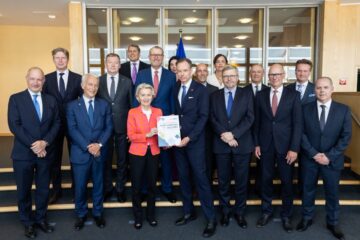
Through its leadership and its Brussels office, and in its capacity as a member of BusinessEurope, SEV actively participates in consultations on European industrial, energy and climate policies, putting forward concrete proposals. Its contribution to the consultation on the revision of the EU ETS forms part of this broader effort to engage in dialogue with the European Commission. In its meetings with BusinessEurope and the President of the European Commission, Ursula von der Leyen, SEV consistently highlights the critical issues affecting industrial competitiveness.
For SEV, the pace of industrial decarbonisation must be aligned with the industry’s realistic capacity to invest in green technologies. Otherwise, achieving climate targets could come at a high cost: the deindustrialisation of Europe. Avoiding this outcome requires a policy framework that provides companies with genuine incentives to invest in clean technologies while enabling them to remain competitive with producers in third countries.
The Commission’s proposal improves the existing framework but fails to provide convincing answers to the major challenges facing European and Greek industry. In its submission, SEV therefore highlights the following priorities:
- The need for a greater reduction in the Linear Reduction Factor (LRF), particularly during the first half of the 2031–2040 period. The LRF determines the annual rate at which the overall cap on emissions allowances is reduced. This is particularly important in the first years of the period, when companies covered by the EU ETS will be required to make critical investment decisions. Under the Commission’s proposal, the LRF will stand at 3.7% for 2031–2035 (down from 4.4% in 2028–2030) and at 1.7% for 2036–2040. While the proposed slowdown in the LRF is viewed positively in principle, SEV considers that the reduction should be greater during the initial years of the 2031–2040 period.
- The need for stronger protection of European production, particularly during the critical transition period of 2031–2035, until the effectiveness of the Carbon Border Adjustment Mechanism (CBAM) as a safeguard against carbon leakage has been demonstrated in practice. Carbon leakage refers to the risk of production relocating to countries with less stringent climate rules.
- The need to maintain free CO₂ emission allowances for exported production, in a manner compatible with World Trade Organization (WTO) rules, in order to safeguard export competitiveness. Free CO₂ emission allowances are being phased out for products such as steel, cement, aluminium and fertilisers, and replaced by a carbon charge on imports under the CBAM. As free allowances are reduced, European exporters will face increasing carbon costs, while their competitors will not bear equivalent costs for their emissions. SEV has therefore submitted alternative proposals for the European Commission to consider.
- The withdrawal of the proposed link between free allocation and additional investment obligations. In principle, this conditionality is incompatible with the purpose of free allowances, which is to protect European production from competitors that do not pay for their emissions. In practice, it would require industry to undertake investments even where the necessary economic and technological conditions for making them genuinely viable are not in place.
Finally, the consultation on the proposed framework for applying the ETS to maritime transport is of particular importance to Greece. The country’s geographical position, its reliance on maritime and road transport, and gaps in critical interconnection infrastructure call for a tailored approach. Otherwise, there is a risk of imposing a disproportionate burden on the transport of goods, supply chains and energy.