Greece recovers at slow pace… – SEV’s monthly economic bulletin
Consumer confidence rises as business confidence wanes – SEV’s monthly economic bulletin
Business Pulse survey results 2018
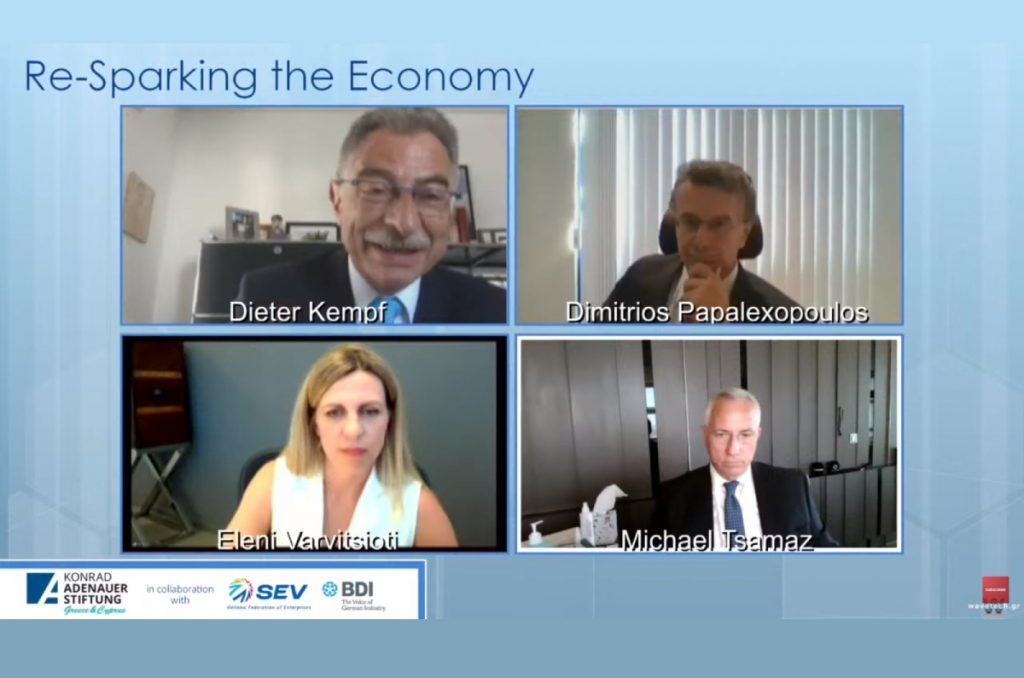
E-discussion between SEV Chairman D. Papalexopoulos, and BDI President D. Kempf
The digital event on re-sparking the economy after COVID19 was organized by the Konrad Adenauer Stiftung (KAS) for Greece and Cyprus, in cooperation with SEV and BDI on June 25th. SEV – Hellenic Federation of Enterprises Chairman, Mr. Dimitris Papalexopoulos, and BDI President, Dr. Dieter Kempf, exchanged views on the growth challenges and the prospects for a V-shaped recovery in Europe and Greece. They were joined by Mr. Michael Tsamaz, Managing Director & CEO, OTE Group, and Mr. Henri-Giscard Bohnet, Director of KAS for Greece and Cyprus. The discussion was moderated by Mrs. Eleni Varvitsioti, Journalist.
The discussion focused on the way that the business communities of Greece and Germany responded to unprecedented circumstances, on the national and European instruments that have proved most effective in managing the COVID19 crisis, as well as on the policy priorities for the coming period.
Mr. Papalexopoulos underlined the need to build closer links between businesses and society, and emphasized the importance of increasing industry’s share in GDP, through more investments and speeding up the pace of reforms.
He also noted that Greece’s response to the health emergency demonstrated the very good reflexes of the public administration and citizens alike, and helped improve the country’s collective confidence creating the conditions for the country’s positive rebranding and re-alignment on the global stage. He also underlined the importance of a united Europe, and Greece’s commitment to the European vision, especially at a time our continent faced important challenges.
Mr. Papalexopoulos added that the health crisis is forcing us to think differently and to act intelligently. Greece, he said, is called to rise to the challenges of the post-Covid-19 world and to restart its economy, which despite significant progress, appears weaker than its European counterparts’ because of the long financial crisis. He stressed the need for greater consistency and speed of reforms as well as a socially responsible and effective management of EU Recovery funds.
The main priorities for a dynamic restart of the Greek economy stem from the need to strengthen its productive base through increased investment in infrastructure, with particular emphasis on digital transformation, the green and circular economy, and improving skills throughout the workforce at a time when also international supply chains are being redesigned. Mr. Papalexopoulos also highlighted the emerging investment opportunities in many key productive sectors of the Greek economy including the agro-food industry, pharmaceuticals, energy efficiency, waste management and logistics, and the growth impetus offered by the country’s valuable human capital.
Dr. Kempf noted that the European supply chains need to be redesigned taking into consideration not just economic costs but sovereignty costs as well, and stressed that the EU is the only way for Europe to remain an important global economic actor. He remarked that the current health crisis is very different from the financial crisis of 2010, and therefore the European policy response cannot be based on the same arguments as a decade ago. He underlined the need for a “Clever Green Deal”: an integrated strategy for green growth and post-COVID recovery, including substantial encouragement to SMEs for investment in digitization. Dr. Kempf warned that Europeans should remain alert to the virus, otherwise the current euphoria of dealing with the first wave may end up being self-destructive.
Click here to watch the full discussion
Click here for more information on the event
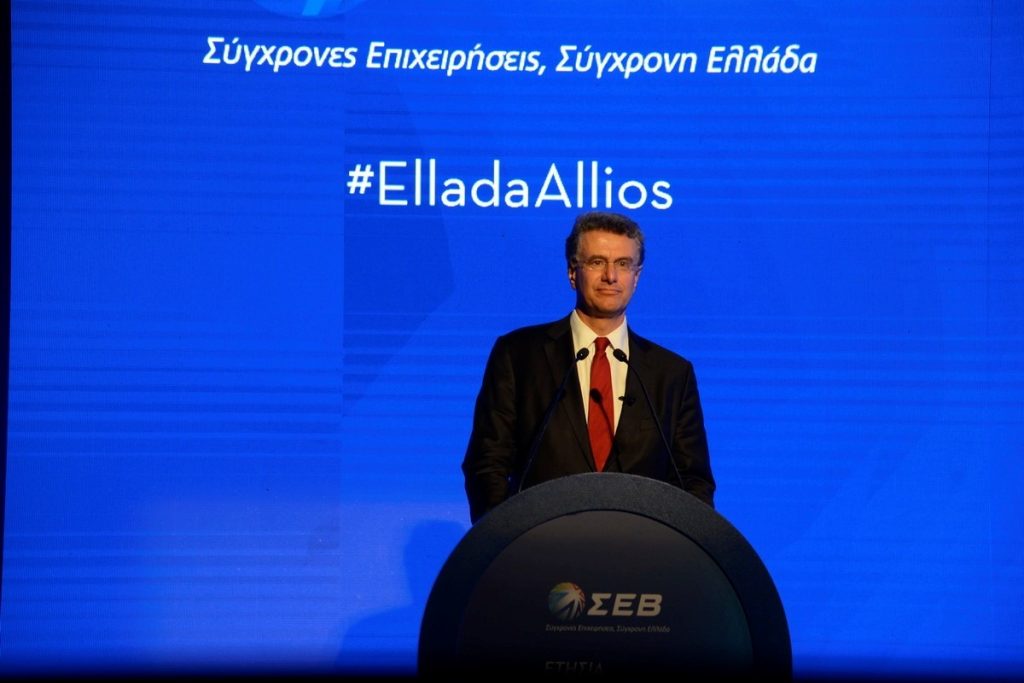
New SEV Chairman, Dimitri Papalexopoulos speech at SEV Annual General Meeting
Prime Minister,
Dear members of the Board of Directors,
Dear Friends,
I welcome you, in turn, to the open event that is traditionally held following the SEV General Meeting. I’m sorry that conditions are keeping us apart, and this opportunity for us to meet adds to the endless list of online events in recent months.
I would like to start by thanking the members of SEV for putting their trust in me and in the new Chair of the Executive Committee, Efthymios Vidalis. We will do everything in our power to prove worthy of this honor.
And also worthy of succeeding Thodoros Fessas, who worked tirelessly for the Federation and leaves behind a strong and dynamic organization that is looking to the future.
As the Chairman of our Federation, he managed situations under adverse conditions, while at the same time strengthening the organization and its voice in the public debate.
With ethos, hard work and common sense, he succeeded in collaborating with everyone. He did important work, defending pragmatism and participating actively and constructively in the social debate, honoring his role as the leader of an institutional social partner.
During his chairmanship, SEV grew. It gained 340 new members, flourished throughout the Regions of Greece, and put great emphasis on the openness of Greek enterprises. Today, the employees at companies that are direct members of SEV number some 200,000 [and many more if we include affiliates of SEV members].
Thodoros, on behalf of everyone, I thank you for all of this and much more. It would be a great thing if Greece had more leaders who understood their role in public life as you do.
***
My address today will focus on five key topics:
First, on how we perceive SEV’s role.
Second, on the need for enterprises to get closer to society.
Third, on the importance of industry’s increased significance in the economy as a whole.
Fourth, on the three primary horizontal priorities we need to embrace: the digital revolution, enhancing skills in the labor market, and green growth.
And last but not least, on managing the crisis caused by the pandemic.
1: SEV’s twofold role
I’ll start with how we perceive SEV’s role.
The Hellenic Federation of Enterprises (SEV) has its roots in industry. It strives to effectively represent manufacturing and the importance of manufacturing for the Greek economy.
What’s more, the strengthening of manufacturing in Greece is an extremely critical and pressing issue, which I will come back to shortly.
In this effort, SEV incorporates the whole multidimensional ecosystem of enterprises that comprise industry: producers and providers of knowledge, enterprises large and small, in the center but also in the periphery.
At the same time, in recent years we have made a conscious effort to evolve into a voice for all diligent competitive entrepreneurship in Greece.
Not just because many of the issues we deal with, such as taxation, labor issues, justice, training, pension policy, the regulatory environment or funding, are horizontal and concern all the sectors of the economy.
But mainly so that we can gain a common and strong voice for all of us who believe that diligent entrepreneurship that goes hand in hand with the needs of society is perhaps the most important component of long-term growth.
This is why, today, many of the most successful enterprises in all the sectors of the economy have responded to our call and become active members.
With their assistance, we are working to upgrade the whole economy.
We have not earned our right to be heard, to contribute creatively to shaping public policies and to develop new enterprises on the basis of our name or our formal title of Social Partner.
We have earned it by creating solid proposals on every issue, as well as through our efforts to transcend the short-sighted thinking of union representation.
We have earned it by striking a balance between the concerns and interests of our members, on the one hand, and the need for changes. Changes that – even if they seem difficult or unpopular today – we defend when we believe they contribute to the progress of enterprises and society as a whole.
To the degree that we pursue a broader role – that of first among equal representatives of organized entrepreneurship in our country – we have to earn it every day through our actions.
In the end, this twofold nature of SEV – representation of industry and of entrepreneurship in general – is not a dilemma.
We embrace both roles.
And we work to serve them at the same time. Of course, we can do better, but we are on the right path. The significant increase in our members – from all sectors, including industry – confirms this.
2: Enterprises and society
The second topic I would like to address is the relationship between enterprises and society.
Moving forward, we believe that building a new relationship of trust between enterprises and society is one of the key goals that we must pursue.
It is a fact that society often does not embrace us – does not trust entrepreneurship. It sees entrepreneurship as something distant. And we have to admit that this suspicion is, to some extent, understandable; it isn’t just the result of populism.
The economy we are striving in is small, with a tradition of introversion and over-regulation. It is an economy in which honesty is rarely rewarded and failure to meet one’s obligations is rarely punished. As a result, there have been distortions of competition, as well as cynical practices that cause many people to understandably question enterprises’ contribution to the common good.
Today, the way enterprises have responded to social needs, in combination with the maturity and awareness of our society, has created the conditions for throwing off the burden of the past.
At SEV, we believe it is our responsibility to reverse this perception. Strengthening of the relationship between enterprises and society depends first and foremost on us, the enterprises. Starting with a willingness to take a hard look at ourselves and make improvements.
The more we evolve for the better, the stronger our relationship with society will become. The more we invest in meritocracy, training and development of our employees, in open competition, in innovation, in sustainable development, in good governance and corporate social responsibility, the more we can reduce this distance. And the more entrepreneurship can legitimately ask for the state’s assistance in pursuing growth.
A critical mass of enterprises has embraced this need. And SEV will strengthen this trend through solid proposals for reforms, provision of knowledge, promotion of good practices that exist in our country and are gradually becoming more widespread.
The state, in turn, can contribute to the liberation of the economy’s productive forces. Creating a clear and serious regulatory framework that supports us. Avoiding the role of entrepreneur, in which it has repeatedly failed. Promoting the much-discussed but necessary reforms in licensing, spatial planning, the speed with which the courts issue rulings, reduction of red tape, tax legislation. Reducing, as a priority, the tax burden of labor (ideally in a way that encourages young people who have gone abroad to return home). Supporting innovation and effective linking of education with the needs of the modern market. Helping to make entrepreneurship fashionable among young people; putting it in our schools; marrying it with our educational system.
Prime Minister,
Enterprises see in you someone who sincerely believes that entrepreneurship is part of the solution for the future of our country. We all agree that in countries where society, enterprises and the state come closer together, there are significant benefits for everyone. SEV will be the first to contribute in this direction, and it hopes for a positive response.
3: Shift towards manufacturing
The third topic I would like to discuss today is the emphasis we plan to put on the development of industry.
Since the mid-1980s, industry’s added value for the economy has fallen. In part, this was the result of unavoidable international trends. But it was also the result of incorrect choices. Think back to the unbridled consumerism and erosion of production at the beginning of the century.
Industry’s current direct participation in GDP is estimated at about 10%. But this percentage undervalues its contribution.
According to IOBE data (2018), nearly 1/3 of GDP and employment derives from the direct, indirect or induced impact of manufacturing.
Manufacturing’s total multiplier in GDP is 2.8, and 3.5 in employment, benefiting services and commerce and creating a vital ecosystem of SMEs.
Manufacturing accounts for 44% of total exports, pays salaries that are on average significantly higher than in the rest of the economy, and contributes more than its share to state revenues.
So, manufacturing’s contribution to GDP has multiplying benefits.
It is thus no coincidence that the EU’s goal is to increase manufacturing’s participation to 20% on the European level.
SEV’s primary goal is to increase industry’s contribution to GDP from 10% to 15% over ten years.
If we achieve this goal, we estimate that, gradually, we will see the creation of 550,000 new, well-paid and stable jobs in our country.
To understand of the magnitude of the shortfall, as well as the magnitude of the opportunity, we need only look at what is happening in other European countries that are quite similar to Greece, such as Portugal.
Portugal exports €53 billion in industrial products, compared to about €30 billion in our country.
Due to this industrial openness, 17% of employees work for industrial enterprises, compared to 9% in Greece. SMEs benefit similarly, contributing 57% of exports, compared to 45% in Greece.
This may seem like an ambitious goal, but the circumstances are better than they have been in many years.
It helps that the EU is moving in the same direction. That the geopolitical changes are creating opportunities for Europe’s supply chains to move closer to home. That access to technology is easier than ever before. That Europe is providing funding that can impart momentum. That the long years of the crisis (in combination with the difficult circumstances for our tourism sector) have created broad agreement on the issue.
There are sectors in which, as a country, we have a comparative advantage, and we can develop these sectors. Metals, food, pharmaceutical industry, green energy, mineral wealth, shipping and some high-tech sectors are just a few.
We can certainly do better. What do we need in order to achieve this?
This is a broader debate that has to be carried out immediately. However, we would include the following as key ingredients for success:
– Continuation and acceleration of the much-discussed reforms (which I mentioned earlier), which concern mainly removing obstacles that (all) enterprises have to deal with.
– Drawing up of a clearly defined industrial policy, in line with that of the EU.
– Securing competitive energy prices.
– Systematic bolstering of our ability to innovate.
– Earmarking of adequate funding for investment in necessary infrastructure – especially digital, energy, circular economy and logistics infrastructure.
– And finally, our alignment behind certain critical imperatives of our time: the digital revolution, the necessary skills for our labor force, and green growth.
Prime Minister,
Global economic and geopolitical developments have shown the importance of domestic industry and a modern industrial policy. On the EU level, the issue is already being approached pragmatically and with a sense of urgency. The corresponding debate in Greece has been late in coming. SEV is prepared to participate in and give all its support to the collective effort required to achieve the goal.
4: Three horizontal priorities
I would like to make a separate and brief reference to the horizontal priorities I just mentioned: the digital revolution, the necessary skills for our labor force, and green growth.
each of the three holds risks and opportunities for Greece. SEV has developed multifaceted action on each of the three. We will commit ourselves further to each of the three.
We support and strengthen the upgrading of Greek enterprises’ digital capabilities, so that they can close the digital gap between Greece and most European countries.
The coronavirus crisis gave us an unexpected push in this direction. A major step forward was taken with digitization reforms in the public sector, and the government and all those who contributed to this deserve our congratulations. Now we have an opportunity to pick up the pace, all together.We believe in the need for substantial upgrading of the skills of our current and future human resources – of young people.
We intend to take additional initiatives to support the linking of education with the labor market, in the hope that the time is finally ripe and there is consensus on a major step forward on this critical issue.
We are investing in strengthening our collective capability to innovate, as a key condition for growth with well-paid jobs. Greece has excellent scientists, at home and abroad. If we succeed in bringing them closer to our enterprises, to the market’s applied innovation, we all stand to gain. And at the same time we will support start-up enterprises that have enormous potential.
We actively support European and national initiatives for green growth, circular economy and energy transformation. At the same time, of course, ensuring that the competitiveness of industry is protected from potential unfair competition from outside the EU. As a country, we have comparative advantages on which we can build.
These challenges have become a focal point throughout the world, as well as in Greece. The changes entailed are momentous and the pace of the changes is very rapid. We need to see everything we do in the light of responding to these challenges.
Prime Minister,
You have promoted these priorities as a government. However, we need to go farther faster. We will be your allies in promoting these priorities with determination.
5: Coronavirus and management of the crisis
If we had held our General Meeting a few months ago, my speech would end about here. These, I would say, are the challenges we have before us. I would speak with cautious optimism.
The coronavirus crisis changed everything. 2020, at the very least, will be a very difficult year.
Many enterprises are once again concerned about survival. The 30-year-olds who have experienced two successive crises are worried about their careers. Expectations were shattered at the most critical moment: just when we believed we had left the economic crisis behind and the time had come for us to surge ahead.
The government – whose successful management of the health crisis so far has been acknowledged by everyone – has some difficult decisions to make about how to mitigate the impact of the economic crisis: with what priorities and what resources. Our proposals are along the following lines:
Responding to the pandemic and protecting human life are still the first priority. We continue to comply with the measures for protecting the health of our employees, our customers, our suppliers. At the same time, we support the national effort, beyond our business footprint, through donations of equipment and logistical support [our members have already donated tens of millions].
Second, we believe that the economic measures, beyond the protection of vulnerable groups, must support jobs and production (of products and services), to safeguard as much as possible the fragile health of our country’s productive fabric. The initiatives the government has already taken are in the right direction.
Third, responding to the crisis must not distract us from our strategic goals or serve as an alibi for avoiding the necessary reforms, which have to move forward more quickly.
Fourth, the coming European funds give us a new opportunity to break free of the history of missed opportunities and wastefulness of the past. Strengthening investments in critical infrastructure, as well as private productive investments, help in the long term and strategically.
I’d like to emphasise something at this point. Private productive investments weathered the crisis. Indicatively, from 2007 to 2017, investments in industry fell by 5%, while GDP shrunk by 25%.
However, this is not enough. The implementation of domestic investments, along with attracting foreign investment, remains at significantly lower levels that what is required for long-term sustainable growth. Increasing these investment remains a major challenge, and we hope to contribute substantially to meeting this challenge. There is cause for optimism: In recent years, the taboos of the past were broken. It is especially positive that, in spite of any individual disagreements, there is consensus among the major political parties that investments and risk are necessary if the country is to move ahead.
And something else. The health crisis has brought an opportunity. Our common goal pushed us to work collectively and effectively. The Opposition rose to the occasion. It seems that a more hopeful model of debate and dialogue is emerging, both in politics and in society.
We have to capitalize on this window of opportunity before it closes. This is our chance to resolve issues that for years have kept our country from making the transition to a new productive model.
***
Ladies and Gentlemen,
We talked about the need for trust between enterprises and society, and how we can build this trust, taking the first step ourselves, as enterprises.
About the need to transform our traditionally closed economy into an open, innovative and competitive economy.
About the Greece that produces and the importance of manufacturing.
About how we can accelerate the younger generation’s mastery of skills needed in the future, in a changing world, creating the conditions for more opportunities and better salaries.
We talked about what’s at stake in the digital revolution and green growth.
Finally, we talked about the major issue of working together; whenever we succeed in doing so, we show our best selves.
We are well aware that all of this cannot change by magic, automatically, overnight. It takes time, commitment, collaboration.
In the pandemic crisis, we, as a people, showed the whole world – and, even more so, ourselves – that we can do better.
And this helps us to strengthen our collective self-confidence, which we had lost for a time.
At SEV, we believe in the Greece that perseveres and succeeds, through collective effort. In all of the sectors and on all of the priorities, we will endeavor to deliver tangible and measurable results for enterprises, for the economy, for the progress of our society.
***
Thank you.
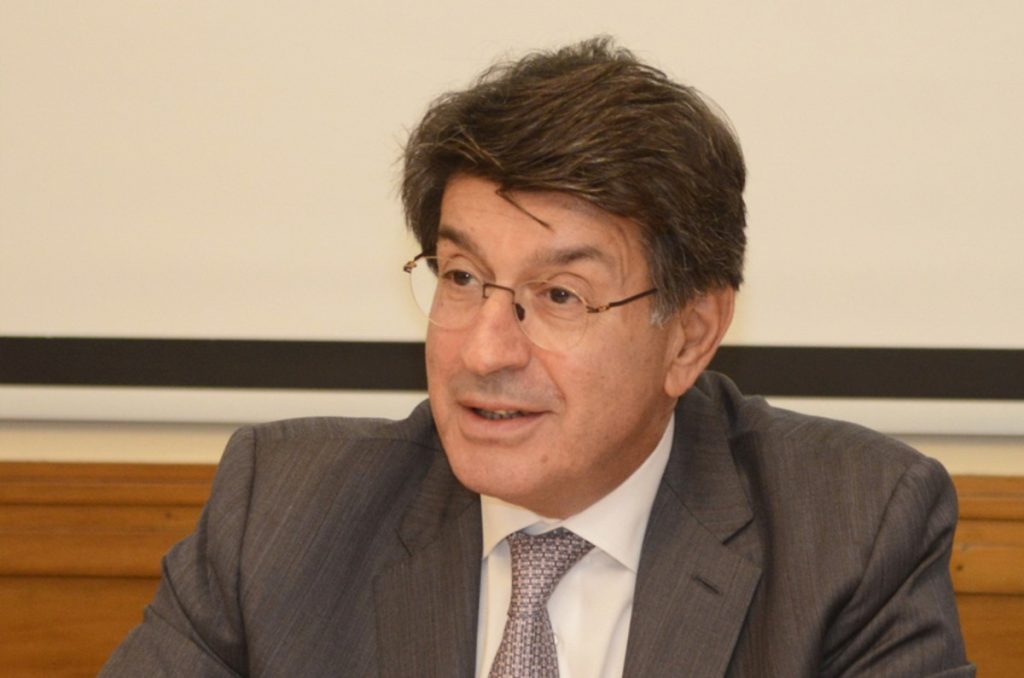
Theodore Fessas: “To support investment activity, Greece offers substantial incentives for large-scale strategic investments”
SEV Hellenic Federation of Enterprises is a leader in the business community in Greece as the oldest business federation in the country. Theodore Fessas, President of SEV, discusses the potential of the Greek economy, sectors he finds poised for rapid growth, as well as initiatives SEV is pushing for such as reducing corporate and individual taxation, privatization, strengthening industry-academia collaboration, and increasing incentives packages to stimulate investment in the Greek economy. Mr. Fessas emphasized the importance of Germany as a trade and investment partner, and sees Germany as a key partner as Greece transforms its economy in preparation for the Fourth Industrial Revolution.
The Greek economy is gaining momentum achieving a growth rate of 1.9 percent in 2018. How would you describe the economic turnaround in real terms and what is your assessment of Greece’s progress from an economic point of view?
Economic growth for 2020 is expected to be above the European Union average. Sovereign bond yields are at historical lows. Greece is riding a wave of increasing optimism; business expectations and consumer confidence are surging, and rapid investment growth is expected to improve productivity and competitiveness. Steps are being taken to reduce corporate and personal taxation, but more is needed. The biggest wager is whether the current economic climate, people’s perceptions and new legislation can be transformed into an investment wave on all fronts. Steps have already been taken towards reducing bureaucracy, simplifying licensing, as well as facilitating large scale investments. Transforming taxation into an instrument for growth through hyper-depreciations and other incentives are also expected to help investment. Nevertheless, the key challenge lies in widening the tax base and eliminating tax evasion. In addition, accelerating the digital strategy and overhauling public administration structures are crucial for Greece’s first wave adaptation to the Fourth Industrial Revolution.
To support investment activity, Greece offers substantial incentives for large-scale strategic investments
Where are the key areas of investment opportunities in Greece currently? Which sectors do you see as the primary engines for growth?
Greece presents industrial investment opportunities in mining, energy, water, basic metals, chemicals, pharmaceuticals and foods, as well as in more traditional sectors such as tourism, retail, logistics and construction. More recently, investments in more mature industries have been complemented with ventures in cutting-edge information and communication technology, as well as in the precision engineering and electronics sectors. There are also investment projects involving infrastructure and linked to privatization and concessions, in roads, rails, seaports, airports, hydroplane ports, and in telecommunication networks. To support investment activity, Greece offers substantial incentives for large-scale strategic investments. In sum, prospects for investment and growth in Greece are rapidly improving. This is bound to lead to an expansion of trade and capital flows, for the mutual benefit of our both countries and peoples. The Greek business community is eagerly willing to strengthen business ties with Germany.
What are the factors needed to increase Greece’s attractiveness as an investment destination?
Greece stands ready to attract investment of the highest caliber. Doing business in Greece requires lifting further red tape and enhancing digitalisation. Privatization is also key for attracting investment. Many public corporations need to be privatized. The focus of the approach should concern improving the quality of public services on offer, as well as their cost-effectiveness. Public-Private Partnerships and concessions can both be vehicles that will unlock the great investment potential in Greece. SEV has proposed the creation of a National Investment Council, headed by the Prime Minister, so that investments become a national priority. However, we further need agreement and cooperation with the government on goals and instruments for job creation and growth.
SEV has proposed the creation of the National Investment Council, headed by the Prime Minister
Despite significant progress made thus far, the Greek economy continues to face major challenges stemming from crisis-related legacies, with brain drain being a notable issue. How can Greece better link the education system to the job market?
In the last decade, 500,000 people left Greece. Among them some of our best young minds, and also many people who simply could not find a job. I do not necessarily believe that leaving the country for a while is a negative thing. Once abroad, horizons broaden and new skills are acquired. Nevertheless, it is becoming a significant problem for companies in Greece, as they experience skill shortages. Reversing the trend is crucial and will be achieved through two different approaches. The first involves improving the competitive environment affecting Greek corporations. Reforms are already underway in this respect, while reducing taxation and social security contributions would help significantly as well. The second aspect is through specific policies for addressing brain drain. The key lies in linking education and the market. This can include incentives for R&D investments to create a fertile environment for the cooperation between universities and businesses for research, collaborations and tackling common challenges. Creating an innovation ecosystem and allowing for the smooth transition from education to the workplace is also a key factor. In this respect, cooperation is needed to ensure that education and skills reflect the needs of the private sector. There is still a skill gap in Greece which worsens the brain drain. At SEV, we advocate for greater and deeper cooperation between public policy, education, and research, and the private sector. In the framework of the Fourth Industrial Revolution, knowledge and skills are constantly evolving. Through cooperation, we can ensure that education remains relevant and helps the graduates’ employment prospects.
In May 2019 you presented the main priorities of the business community for the period 2019-2024, focused on the EU. How do you envision Greece’s role within the EU evolving during this period and how can Greece better promote its national interests within the EU?
A strong Greece is even stronger in a strong EU. Strengthening Greece’s participation in all EU endeavours remains our main objective. We support growth policies aimed at improving the EU’s position in the global economy. We fully support the European goal of increasing industry’s share to 20 percent of GDP, through policies, priorities and finance mechanisms, aimed at improving companies’ adaptability, digital transformation and innovation. We find that our national interests is best served in a just, adaptable and modern union. Other important pillars include climate change, the completion of the energy internal market as a source of improved competitiveness, and of course, Digital Europe. The latter is seen as a key prospect for Greek industry and we are firm believers in Industry 4.0 project to transform the economy and allow us to leapfrog into the 21st century.
How is the Greek-German trade relationship and how can Greece capitalize on the momentum created and shift the perception of German foreign investors?
Germany is a long-standing friend of Greece and one of our strongest, and closest, trading partners. Almost 10 percent of Greek exports go to Germany and 15 percent of our imports come from there. Germany is also a significant FDI partner in Greece. In 2018 alone, German investors invested €459 million, 14 percent of total net FDI in Greece. Our trading relationship is going from strength to strength in both directions. We import from, and export to, Germany in significant volumes, a relationship that hardly faltered even at the peak of the crisis. German companies that have participated in Greek privatization efforts have proven their commitment and abilities. German investors would also be welcome to invest in Greek companies and take advantage relatively low stock valuations and real estate prices, as well as human resources of the highest caliber. Further and deeper cooperation would only make things better. For example, we are very eager to tap into German know-how in the run-up to the Fourth Industrial Revolution. The change of narrative for Greece is already taking place in the German market and globally. Greece is increasingly seen as an opportunity rather than a threat to the European edifice. SEV prides itself on our approach to international cooperation and the business opportunities that may result from it. Our export trade missions bring our members into contact with business opportunities around the world, while our results-based efforts yield numerous business deals. We work hard to demonstrate Greece’s ability to change and exploit the opportunities arising from our potential.
Considering the strengths of the German economy in industry, technology, innovation and renewables among others, what investment opportunities can Greece present that suit the profile of German investors?
Greece has plenty of investment opportunities to offer. Foreign capital net inflows have doubled in recent years, though still, at around €4 billion, they represent just 2 percent of GDP. As expected at the initial phase of a country’s repositioning in the global investment map, most of the foreign investments are in the area of services, mainly tourism, financials, and investments in real estate, specifically housing. What is most needed in our country, however, beyond portfolio investments, is greenfield investment. And the government works hard towards that direction.
Mr. Theodore Fessas interview to Global FDI Reports, Business Reports for Die Welt Newspaper.
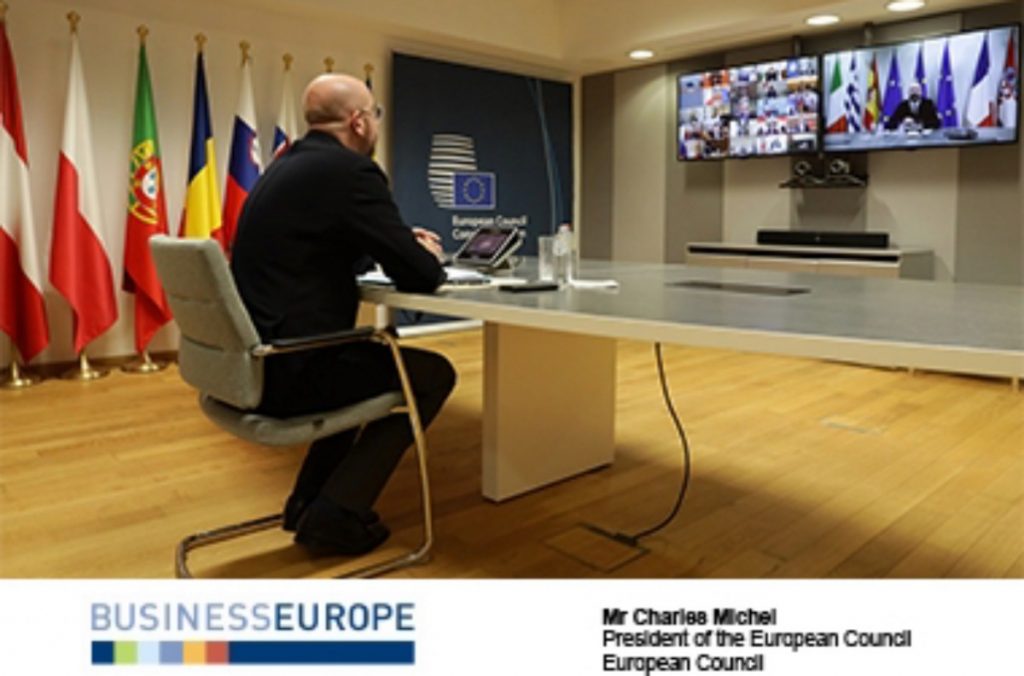
EU business proposals ahead of the European Council
Ahead of the video conference of the members of the European Council on 23 April 2020, BusinessEurope President Pierre Gattaz and Director General Markus J. Beyrer sent a letter to the President of the European Council, Charles Michel and to the President of the European Commission, Ursula von der Leyen. BusinessEurope pleads for a co-ordinated European response to the present coronavirus crisis. We underline the need to better communicate on the emergency measures taken at European level to support Member States. We urge them to take a risk-based approach to organise the exit from current emergency measures. We call for a co-ordinated EU recovery plan, with the EU Corona Response Investment Initiative as the foundation for this broader EU recovery plan. Read the letter here