
Better Regulation & Governance


Better Regulation & Governance

Upgrading the quality of regulatory governance and the effectiveness of public administration through targeted and coherent reforms should be a central pillar of any growth strategy. Improving legislation and the regulatory framework is one of SEV’s top priorities, as it plays a decisive role in unlocking the growth potential of the Greek economy and strengthening its attractiveness as an investment destination. SEV implements initiatives and actions aimed at reducing unnecessary compliance costs and administrative burdens for businesses, enhancing stakeholder participation in policymaking, and improving the overall quality of regulatory interventions.

  • Better regulation and legal certainty: The clarity, simplicity and predictability of the regulatory framework facilitate business compliance, enhance the effectiveness of supervisory mechanisms and reduce the burden on the judicial system, by minimising disputes and strengthening legal certainty. Our objective is the systematic use of better regulation tools, so as to ensure the appropriateness and effectiveness of regulatory interventions affecting businesses, without imposing unnecessary burdens.
  • Strengthening public consultation with business representatives: Upgrading the public consultation system to ensure the timely, substantive and evidence-based contribution of stakeholders to the design and implementation of public policies.
  • Enhancing transparency and combating corruption: Shaping a business-friendly and trustworthy environment, characterised by high regulatory quality, transparency, integrity and accountability.
  • Use of better regulation tools in the legislative process: We support the universal adoption and application of better regulation practices, such as ex-ante and ex-post impact assessments, as essential tools for ensuring the quality of legislative output.
  • Strengthening public consultation with business stakeholders: Consultation with business representatives must take place at an early stage, to ensure that their contribution is meaningfully taken into account in the policy-making process on matters with a significant impact on competitiveness. Furthermore, consultations must be transparent with regard to their timing and duration, participants and representativeness.
  • Reduction of administrative burdens on businesses: We advocate, at both European and national level, for the systematic and measurable reduction of unnecessary administrative burdens and compliance costs arising from legislation, through targeted interventions and evidence-based proposals.
  • Dissemination of best practices for the prevention and combating of corruption: We collaborate with the National Transparency Authority to raise awareness and disseminate best practices for the prevention and combating of corruption in public and private organisations, through workshops, webinars and information events.


CONTACT PERSON

Athena Vounatsou
Director of Tax, Investments & Market Operation

Email me

CONTACT PERSON

Avgi Oikonomidou
Senior Advisor of Tax, Investments & Market Operation

Email me


Related

BusinessEurope Reform Barometer 2019 – Building an EU for European businesses to succeed globally

BusinessEurope’s EU Reform Barometer 2019 “Building an EU for European Businesses to succeed globally”, published on 20 March 2019, shows that the EU needs to do more to improve its competitiveness as EU growth has now been lower than US growth for 7 of the last 10 years. In addition, the Reform Barometer contains our annual survey of our member federations regarding progress on structural reform.

This year’s Reform Barometer looks in particular at how Europe is falling behind in its ability to develop world-leading firms.

We arrive at this conclusion for 3 reasons:

  • None of the top 10 global companies by market capitalisation are European.
  • Western Europe’s share of the top 10% of global firms in terms of profitability has dropped from 36% in the late 1990s to 24% now.
  • Finally, when considering large high-growth firms/’unicorns’ (start-ups that have reached 1 billion dollar market value within a short timeframe), the EU has not matched other regions when it comes to developing such firms, with the number and average value of unicorns in the EU significantly smaller than those in the USA and China.

Against this background it is concerning that, according to our survey of member federations, governments have failed to step up their reform efforts.  Our member federations consider that member states have satisfactorily implemented only 20% of the essential reforms agreed with the EU.

Detailed assessments by national member federations of progress on the country-specific recommendations (CSRs) issued by the European Commission for Greece can be downloaded below.

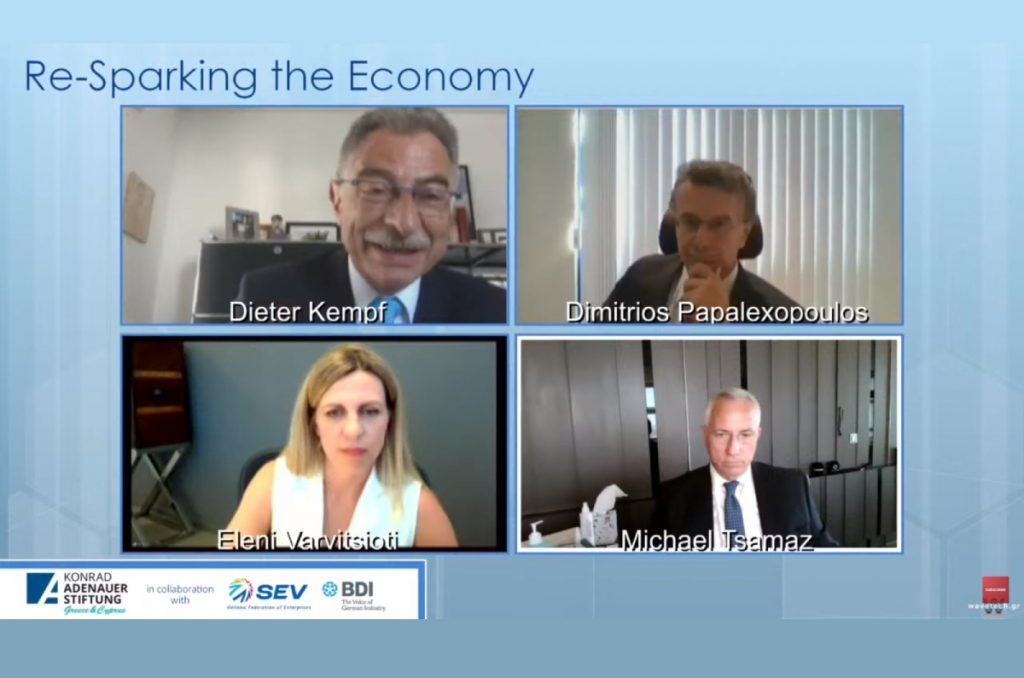
E-discussion between SEV Chairman D. Papalexopoulos, and BDI President D. Kempf

The digital event on re-sparking the economy after COVID19 was organized by the Konrad Adenauer Stiftung (KAS) for Greece and Cyprus, in cooperation with SEV and BDI on June 25th. SEV – Hellenic Federation of Enterprises Chairman, Mr. Dimitris Papalexopoulos, and BDI President, Dr. Dieter Kempf, exchanged views on the growth challenges and the prospects for a V-shaped recovery in Europe and Greece. They were joined by Mr. Michael Tsamaz, Managing Director & CEO, OTE Group, and Mr. Henri-Giscard Bohnet, Director of KAS for Greece and Cyprus. The discussion was moderated by Mrs. Eleni Varvitsioti, Journalist.

The discussion focused on the way that the business communities of Greece and Germany responded to unprecedented circumstances, on the national and European instruments that have proved most effective in managing the COVID19 crisis, as well as on the policy priorities for the coming period.

Mr. Papalexopoulos underlined the need to build closer links between businesses and society, and emphasized the importance of increasing industry’s share in GDP, through more investments and speeding up the pace of reforms.

He also noted that Greece’s response to the health emergency demonstrated the very good reflexes of the public administration and citizens alike, and helped improve the country’s collective confidence creating the conditions for the country’s positive rebranding and re-alignment on the global stage. He also underlined the importance of a united Europe, and Greece’s commitment to the European vision, especially at a time our continent faced important challenges.

Mr. Papalexopoulos added that the health crisis is forcing us to think differently and to act intelligently. Greece, he said, is called to rise to the challenges of the post-Covid-19 world and to restart its economy, which despite significant progress, appears weaker than its European counterparts’ because of the long financial crisis. He stressed the need for greater consistency and speed of reforms as well as a socially responsible and effective management of EU Recovery funds.

The main priorities for a dynamic restart of the Greek economy stem from the need to strengthen its productive base through increased investment in infrastructure, with particular emphasis on digital transformation, the green and circular economy, and improving skills throughout the workforce at a time when also international supply chains are being redesigned. Mr. Papalexopoulos also highlighted the emerging investment opportunities in many key productive sectors of the Greek economy including the agro-food industry, pharmaceuticals, energy efficiency, waste management and logistics, and the growth impetus offered by the country’s valuable human capital.

Dr. Kempf noted that the European supply chains need to be redesigned taking into consideration not just economic costs but sovereignty costs as well, and stressed that the EU is the only way for Europe to remain an important global economic actor. He remarked that the current health crisis is very different from the financial crisis of 2010, and therefore the European policy response cannot be based on the same arguments as a decade ago. He underlined the need for a “Clever Green Deal”: an integrated strategy for green growth and post-COVID recovery, including substantial encouragement to SMEs for investment in digitization. Dr. Kempf warned that Europeans should remain alert to the virus, otherwise the current euphoria of dealing with the first wave may end up being self-destructive.

Click here to watch the full discussion

Click here for more information on the event

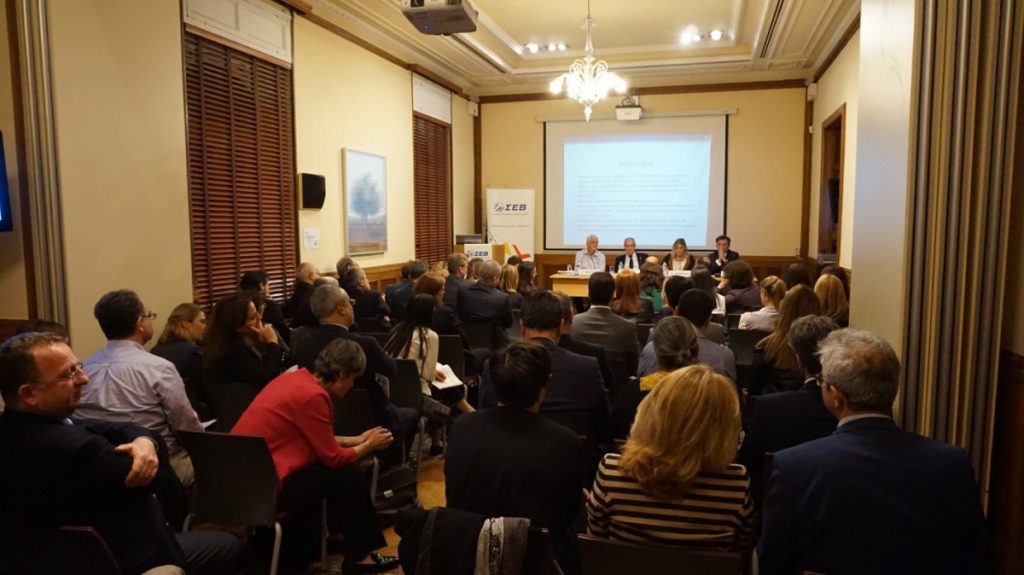
Plenary meeting of Financial Directors, Tax Experts, Corporate Lawyers and other SEV members on the new draft bill on company transformations

The meeting was held on 7th November 2018 with the participation of the Secretary General for Commerce and Consumer Protection and members of the competent legislative drafting committee.
The purpose of the meeting was to inform SEV members in detail on the various legal and tax aspects arising from the new draft bill on company transformations (conversions, mergers and acquisitions).
The new legislative incentive, long needed by the market, is destined to simplify procedures, strike out existing ambiguities, deficiencies and conflicts between the company and tax law provisions that led to the creation of the phenomenon of «arbitrary» transformations.
The Secretary General for Commerce and Consumer Protection and members of the competent legislative drafting committee elaborated and explained in depth the new provisions and amendments, while experts representing SEV members had the chance to emphasize on pending issues such as the harmonization with the relevant tax provisions.

General Board Members Meeting on “corporate governance”

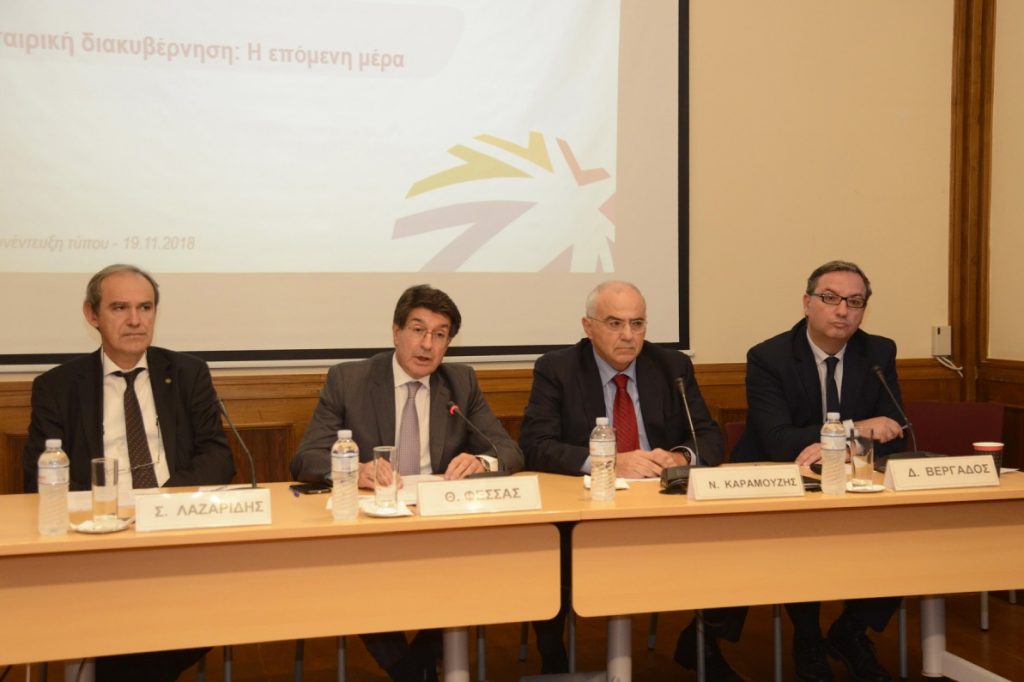
A General Board Members Meeting was held on November 19, 2018 at SEV premises in order to relaunch SEV initiatives on Corporate Governance and address the issues of malpractice that recently surfaced in the Greek market.
Mr. Fessas, President of SEV and representatives of the Hellenic Banks Association, the Athens Stock Exchange, the Hellenic Capital Market Commission and the Hellenic Corporation of Assets and Participations jointly proposed the amendment and update of the existing framework on corporate governance towards a more concrete, effective and modern framework that will activate both companies and public authorities to work more responsibly towards raising the level of corporate governance within Greek companies. To this end, they announced the reestablishment of the Hellenic Corporate Governance Council formed by SEV, the Athens Stock Exchange and the Hellenic Banks Association, as a means of responsible action on behalf of the private sector to assist in the realization of these goals.
Moreover, SEV proposed a set of other legislative improvements that will allow for the creation of enhanced transparency and visibility of corporate actions and make commercial publicity a tool for the establishment of accountability and trust in the market.